A block paving driveway lasts because of what's underneath it, not the blocks on top. Dig deep enough, compact a proper stone base, hold the edges in concrete, fill the joints and make the rain run away, and it stays flat.
Marshalls, the paving manufacturer, say a drive that's properly installed on a well-prepared base should last around 25 years.
"Will it last?" is a question we hear a lot on driveway visits. On a recent extension in Milton Keynes, quality was the homeowner's first worry, so we talked them through the parts nobody sees once the job's finished.
What goes under a block paving driveway?
A block drive is built in layers, each with a job. This is what we lay on a drive that takes cars:
What's under one of our block paving drives
- Blocks50mm
Concrete blocks, vibrated in. The surface you see and drive on.
- Laying course40mm
Sharp sand, a coarse sand, levelled off so every block beds down evenly.
- Sub-base150mm
MOT Type 1, a crushed stone that packs down hard, compacted in layers. It carries the car's weight and spreads it into the ground.
- Membrane
A tough fabric sheet that stops the soil working up into the stone.
- Dug-out ground
Taken down to firm soil before anything goes in.
The sub-base matters most: it carries the car. We compact it in layers, not all at once, because a compactor can only firm up so much stone at a time.
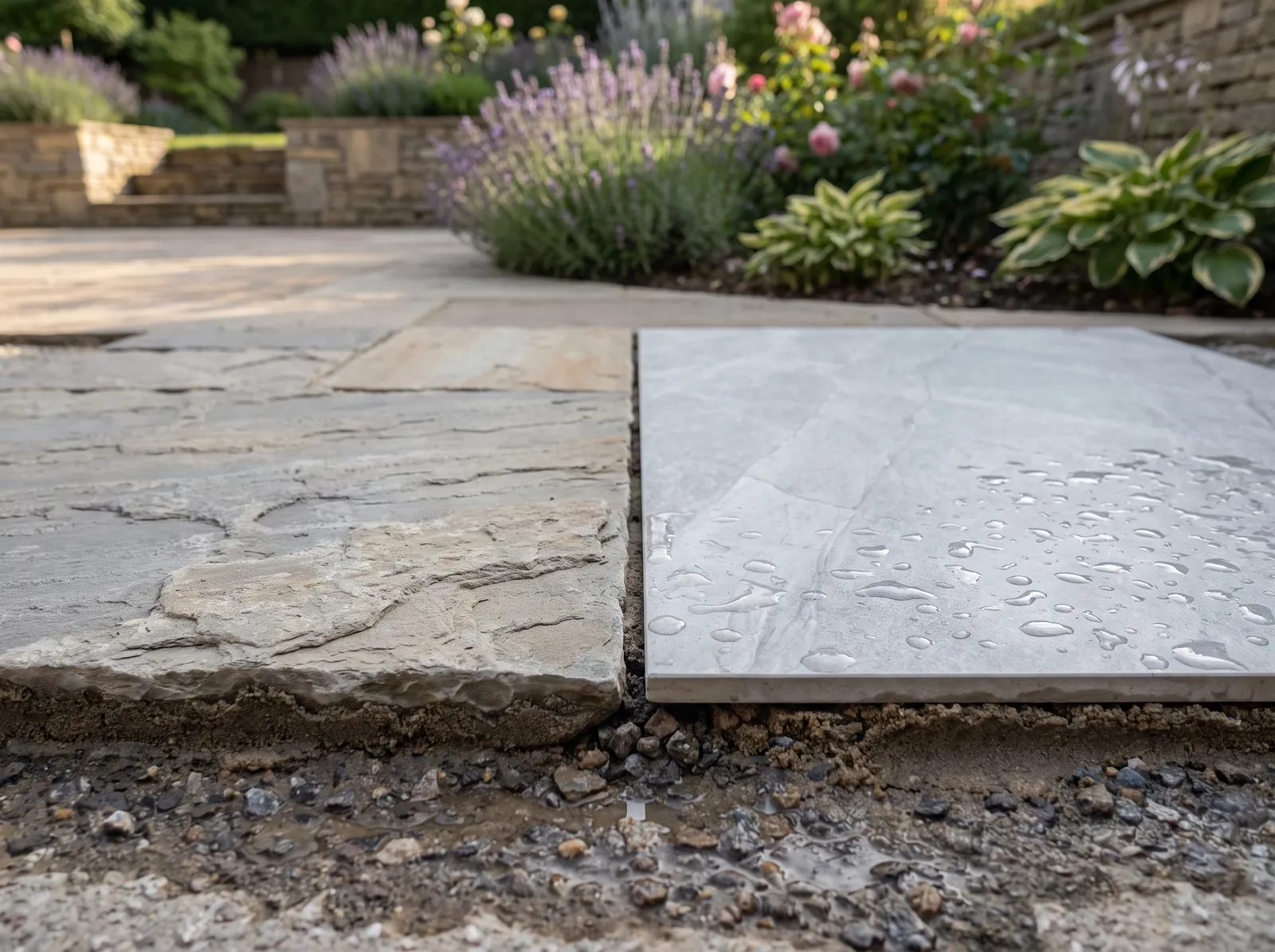
That's why a proper drive needs a proper dig. A firm that only scrapes the top off the old ground can't fit those layers in. It's the same reason patio slabs sink: the surface is only as good as the base under it.
On thickness, 50mm is what we lay on a house drive. Thicker blocks are made for roads and commercial yards. If you park something heavier, like a big van or a motorhome, tell us at the visit. It changes what goes underneath as much as what goes on top.
Why do the edges of a block drive fail first?
The edge restraint is the kerb or row of blocks along every side, set in concrete, that holds the drive in. Block paving isn't stuck down. The blocks stay put because they're packed tight together, and every time a car turns or brakes, it pushes them sideways.
In the middle, each block pushes against its neighbours and nothing moves. At the edge, there's only whatever holds that last row. If that's just blocks sitting on sand, the row creeps outwards a little at a time. The joints open, the sand washes out and the side drops. Then the next row loses its grip, and the problem works inwards.
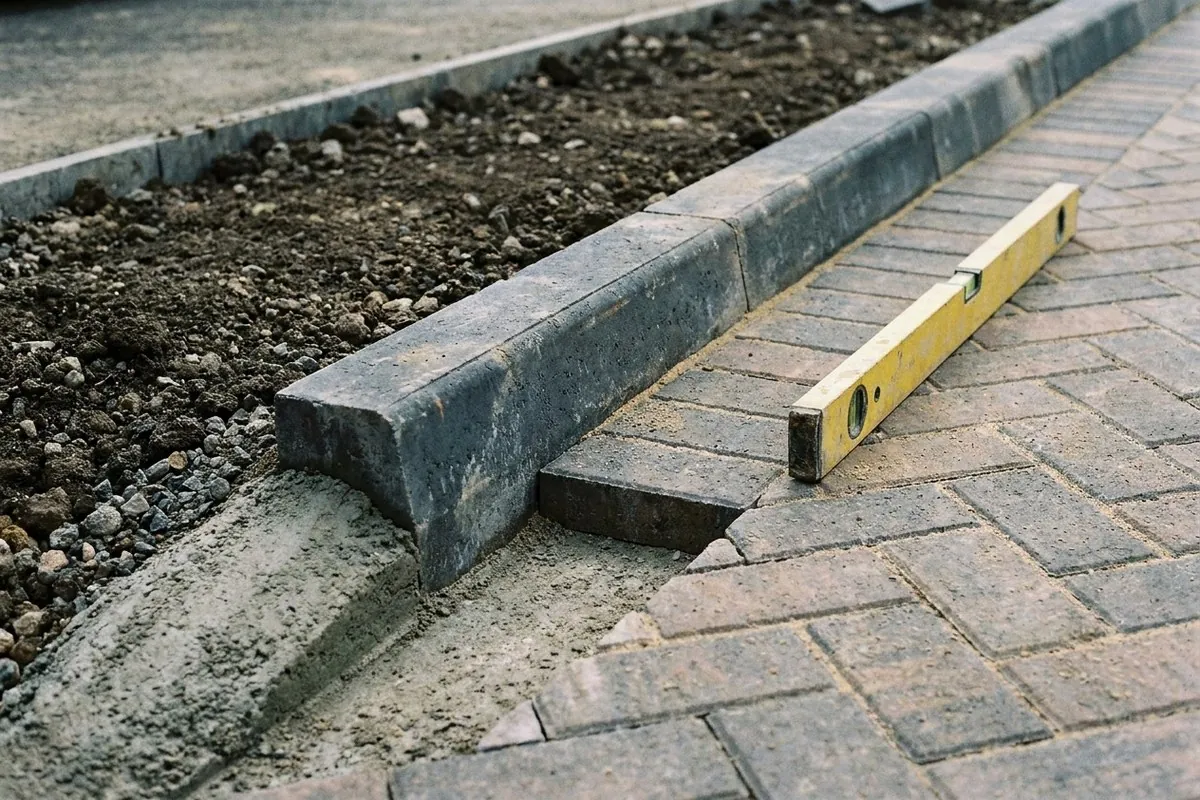
So we set the edge in concrete, with more concrete packed up the outside of it (the trade calls this haunching). Marshalls' laying guide describes edging as like a frame to a picture, holding the drive together. We'd never leave it out.
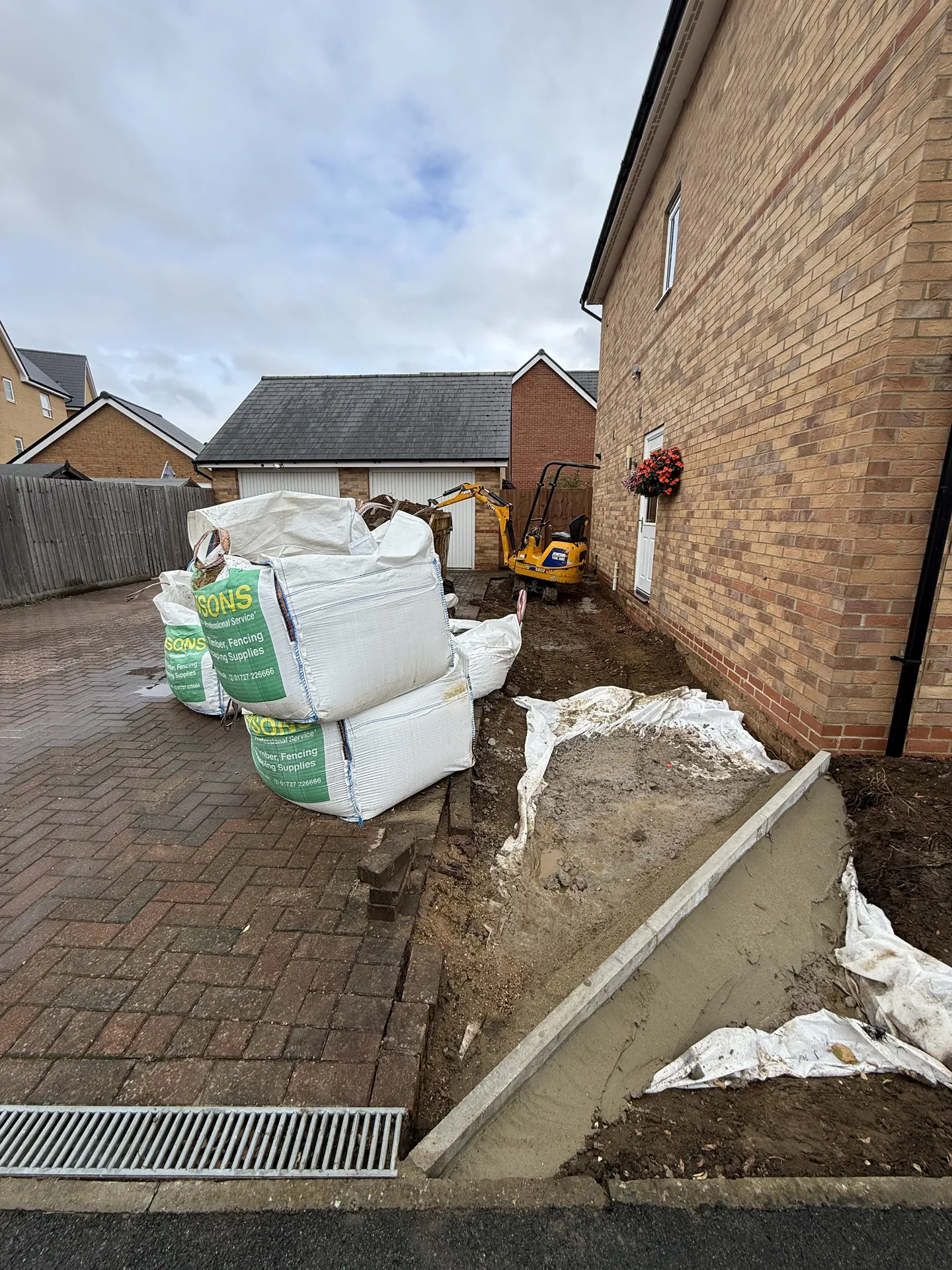
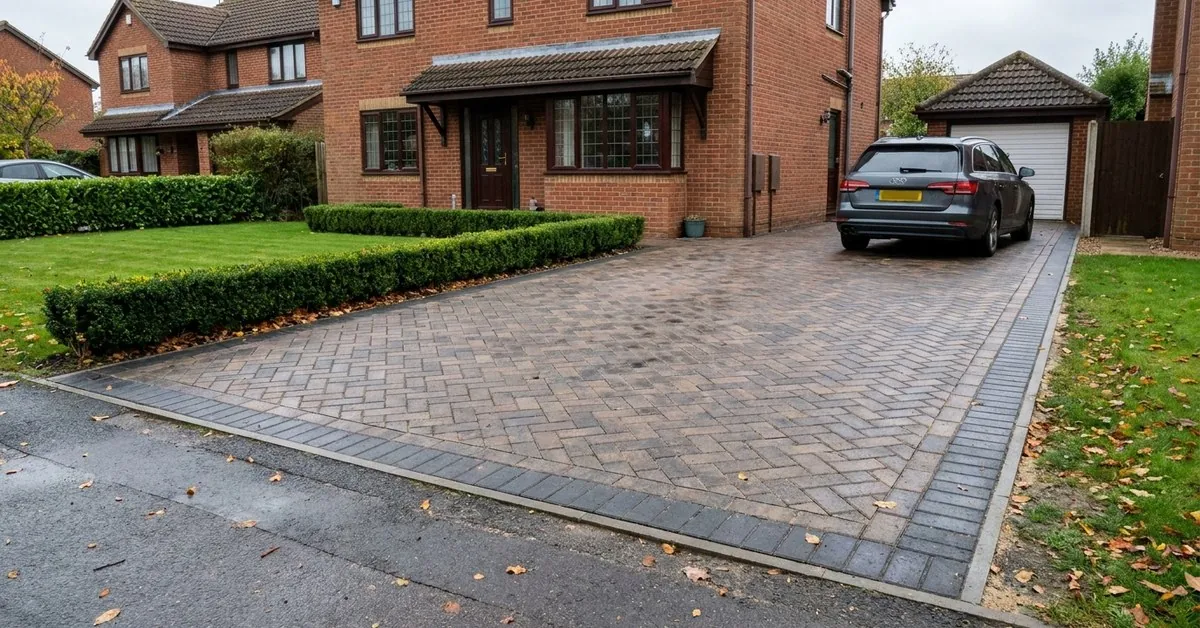
On the Milton Keynes block paving driveway, the new front edge went in at an angle to the corner of the house, set before a single block was laid.
Why kiln-dried sand in the joints?
The sand between the blocks isn't filler. It locks them together, so each block passes the load to the ones around it and a car's weight is shared across the drive instead of pressing on a few blocks.
Kiln-dried sand is very fine sand that's been dried right out, so it runs to the bottom of a narrow joint. Damp sand clogs at the top and leaves a gap underneath. We sweep it in, run the compactor over the blocks to settle it, then sweep in more until the joints are full.
An empty joint lets a block move, and a block that moves starts to rock, wears and sinks. So keep the joints topped up for the life of the drive.
Which way should a block paving driveway slope?
Away from the house, always. Every drive needs falls, the gentle slope built in so rain runs where you want it to. Water that sits on a drive soaks down through the joints into the sand bed, and a wet bed is a weak one. Marshalls' laying guide suggests a fall of about 1cm for every 60cm of drive.
On the Milton Keynes drive, the plan had a strip of shingle along the house wall to catch splashes. On site we left it out: held between two edges, it would have trapped water against the house. The blocks run right up to the wall and slope away from it instead.
Where the ground falls the wrong way, you catch the water. On one recent design that slopes towards the house, a channel drain (a slotted gutter set into the surface) runs along the house side into the drain the garage downpipe already uses. On another, sloping down to the road, the channel sits at the entrance and runs into a soakaway: a stone-filled pit that lets the water soak back into the ground.
There's a planning side too. Standard block paving doesn't let water through. The Planning Portal says a new front drive over five square metres needs planning permission unless the surface lets water through, or the rainwater runs to a lawn or border to drain naturally. On every front drive we plan where that water goes: a border, a lawn or a soakaway. If you live in a conservation area or a listed building, check with your council.
Why do cheap block paving drives sink?
Because the saving is almost always underground, where nobody can check it once the blocks are down. The usual shortcuts:
- A shallow dig. A thin sub-base can't spread a car's weight, so ruts appear where the wheels sit.
- No membrane. Soil works up into the stone and the base loses its strength.
- Edges on sand. The sides creep and drop.
- A thick sand bed. Extra sand to level out a lumpy base settles unevenly, and the drive settles with it.
- No falls. Water sits and softens the bed.
One recent client had moved into a house with a block drive full of dips and bumps. Our quote wasn't to relay the same blocks on the same ground. It was to lift them, take out what was underneath, and rebuild the base properly first.
What we'd do
Spend the money underneath. We build the base the same whichever block goes on top, because it's the part you can't fix later without lifting the whole drive. A plain block on a proper base will outlast a decorative block on a thin one.
For a drive, we'd lay the blocks in herringbone, a zigzag pattern set at 45 degrees to the edges. Each block locks against its neighbours in two directions, so turning tyres can't drag them apart as they can on straight rows.
And we'd set the levels before anything else, so the drive meets the doorstep and the pavement at the right heights. That's design work as much as building, and it's the part a quick quote tends to skip.
If you're weighing up a new drive and want someone to look at the ground, the levels and where the water will go, see how we build driveways. Thinking of selling? Here's whether a new driveway adds value.
Questions people ask
How do I look after a block paving drive?
Sweep it regularly and pull the odd weed from the joints. If you jet wash it, use a wide fan nozzle at a low angle and never point it straight down a joint, because it blasts the sand out. Then brush fresh kiln-dried sand back in. Blot oil drips before they soak in, and never dig out or knock the edging.
Is 50mm block paving thick enough for a driveway?
For family cars, yes, as long as it sits on a proper compacted sub-base with solid edges. The block's thickness matters far less than what's under it. If you park something heavier, like a large van or a motorhome, tell whoever's quoting so they build for it.
Can new blocks be matched to my existing drive?
Usually, yes. In Milton Keynes we matched new brindle blocks to the existing drive in colour and level, so the extension finished as one drive. New blocks look brighter than weathered ones at first, so expect a difference on day one.
Why is there a white powder on my new block paving?
It's natural salt coming out of the concrete, and it's common on new blocks. It fades on its own with the rain, usually over a few months. Don't scrub it.