Patio slabs sink, rock and crack because of what's underneath them, not because of the slabs. Usually it's a sub-base that's too thin or was never compacted, slabs laid on a few dabs of mortar instead of a full bed, or water getting under the patio and softening the ground.
That's why a patio only a few years old can already be rocking. You can usually tell which problem you've got by looking, and it doesn't always mean relaying the whole thing.
Why are my patio slabs sinking?
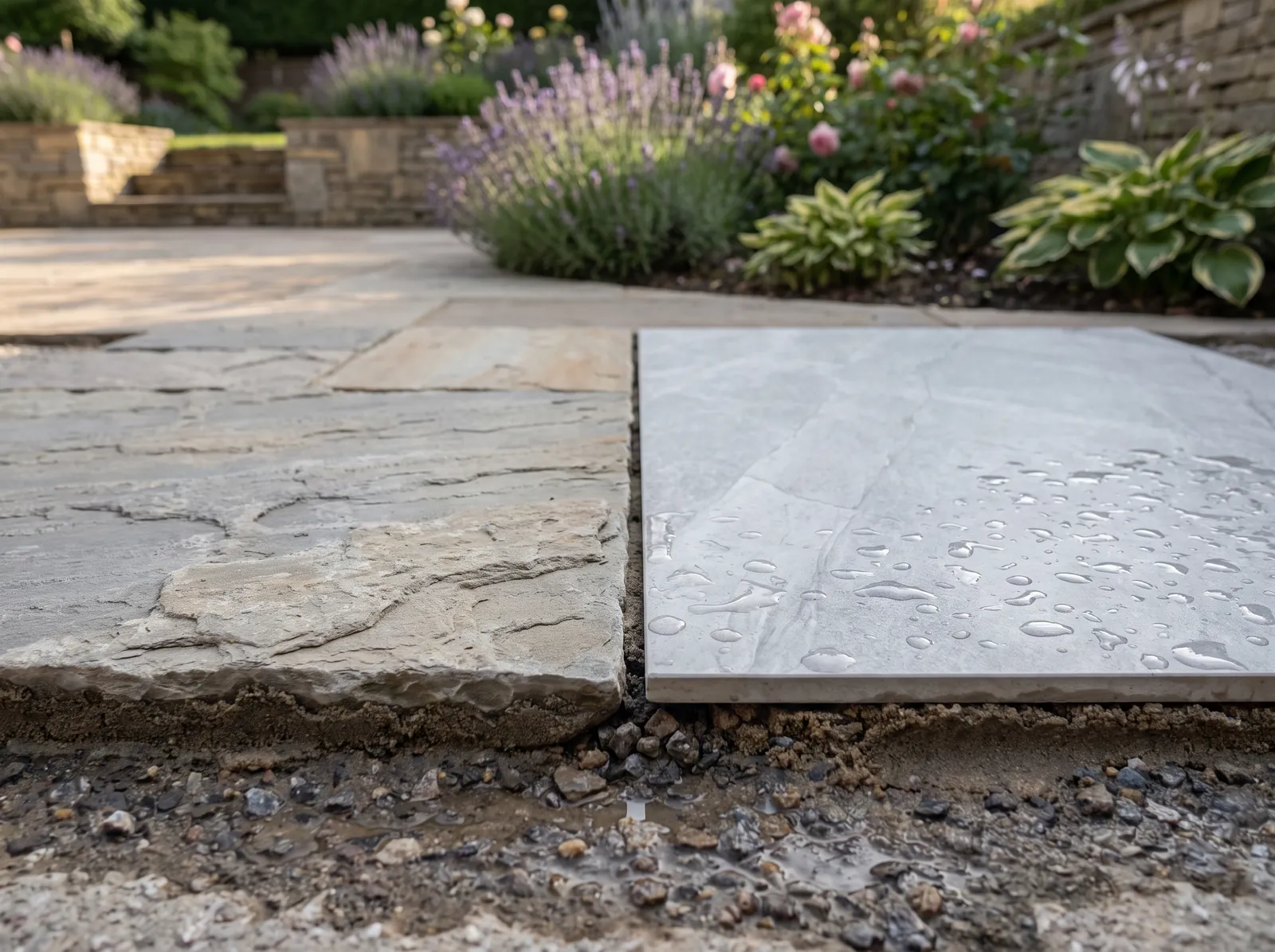
A patio is built in layers, and you only see the top one.
What's under one of our patios
- Slabs and pointing
The stone you see, with the pointing (the mortar between the slabs) keeping water out of the bed.
- Mortar bed40mm
Sand and cement, laid full under the whole of every slab.
- Sub-base100mm
MOT Type 1, a crushed stone, compacted in layers. The patio's foundation.
- Membrane
Keeps the soil and the stone from mixing.
- Dug-out ground
Taken down to firm soil first.
When a patch of patio drops, the sub-base is the first suspect. If it's thin, the weight of the patio and everyone on it presses through into the soil. If the stone was levelled but never properly compacted, it settles over the first winter or two. With no sub-base at all, the slabs sit on soil, which goes soft when it's wet and shrinks when it dries.
Marshalls, the paving manufacturer, says in its laying guide for concrete paving that a poor-quality sub-base "may be liable to failure under loading and be susceptible to frost or moisture movement."
Water makes all of it worse. A patio laid flat, or with a dip in it, holds puddles, the water soaks through the joints, and wet ground is soft ground. That's true whatever the slab, as we explain in our guide to choosing paving materials.
What we found under a patio that sank in a year
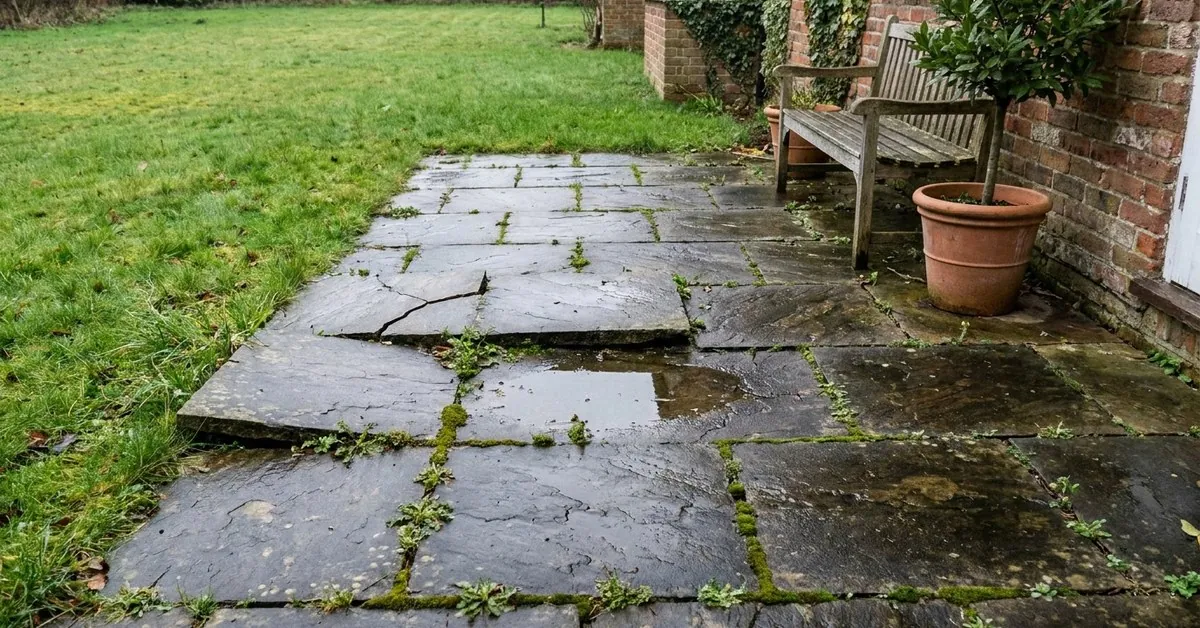
We were asked to look at a sandstone patio in Harpenden that another firm had laid a year before. It was already sinking. The joints were open in places, with moss and weeds growing through, and the granite edge along the lawn was uneven and half lost in the grass.
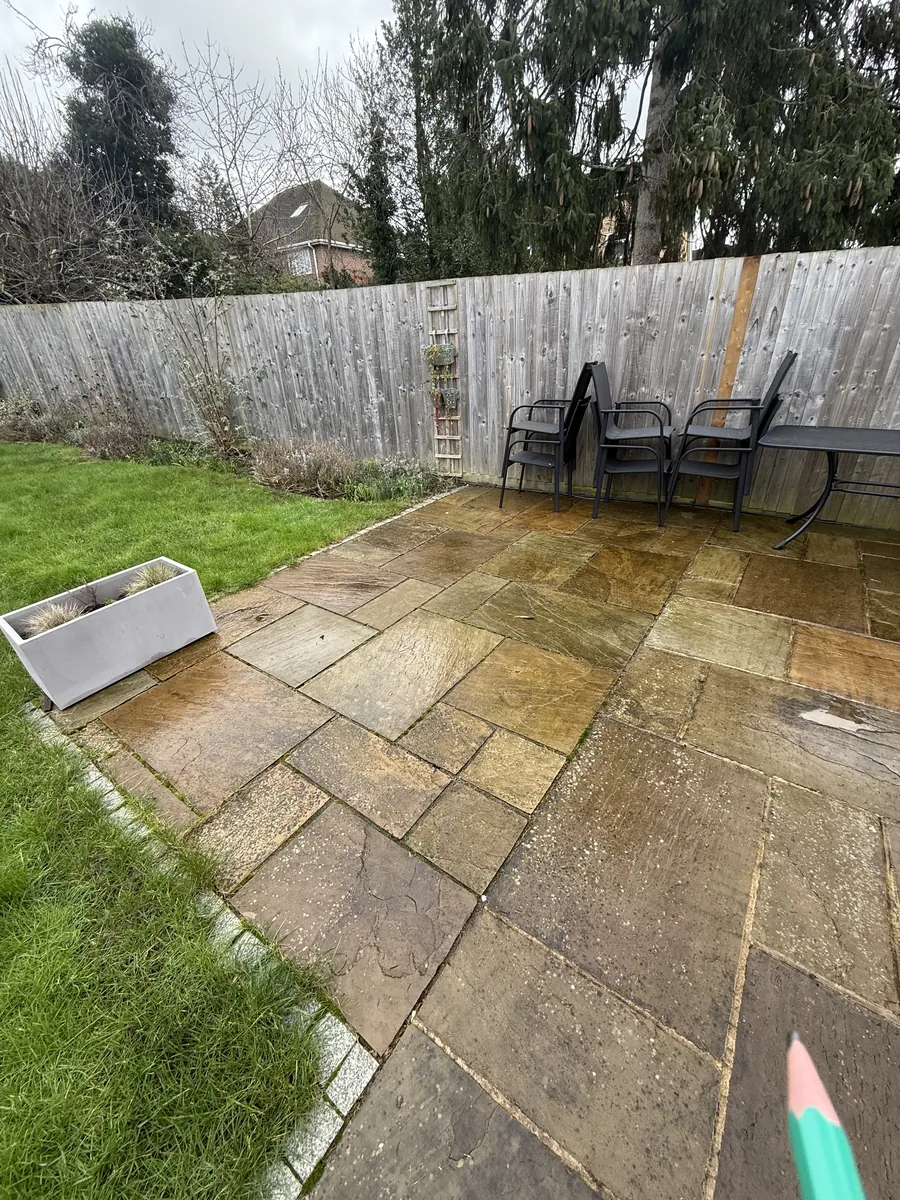
When we lifted the slabs, the reason was plain. In places there was 20mm of MOT Type 1 at most, and some of it you could wipe away with your hand. Parts of the patio sat on bare mud, with no membrane, the sheet that stops soil and stone mixing together.
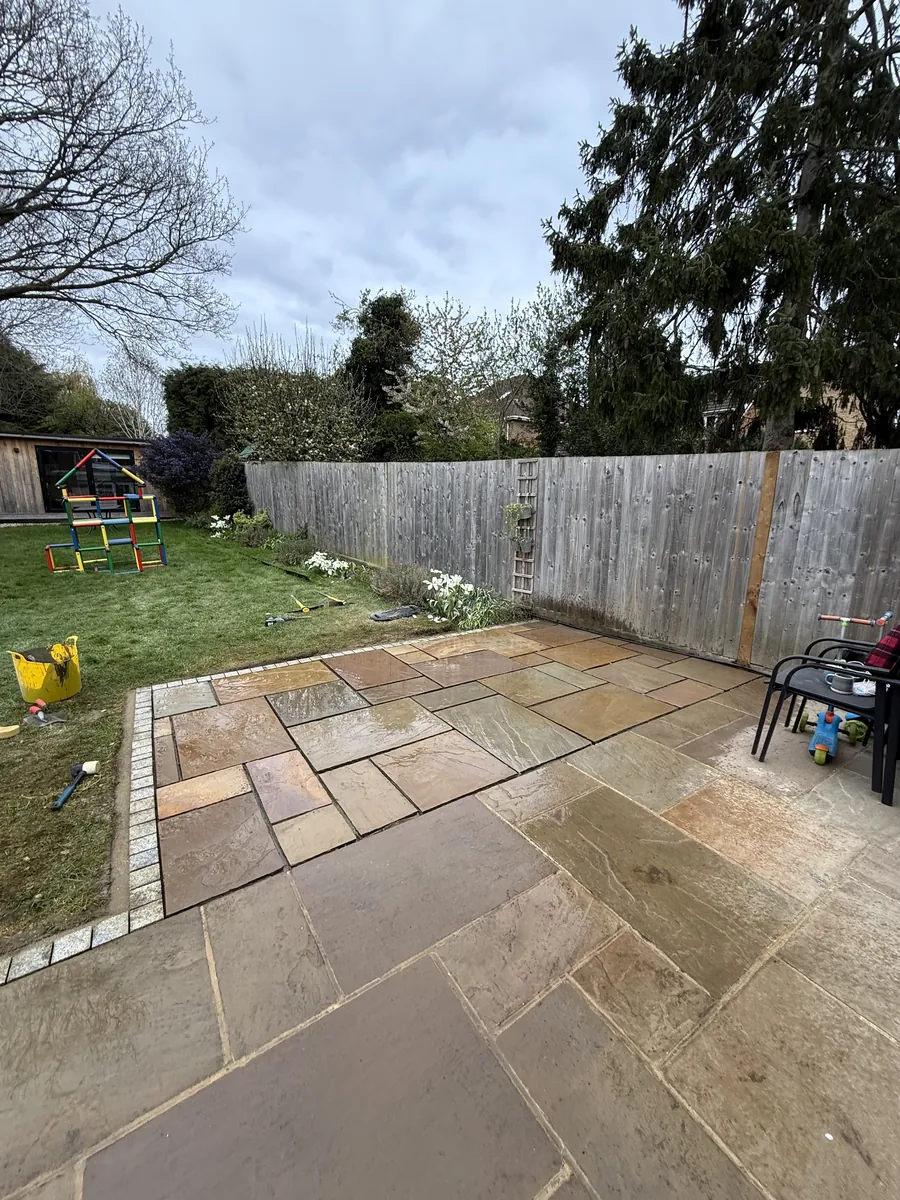
The sinking was along the outer edge, so we lifted that section, dug out what was under it, laid a membrane and a properly compacted MOT Type 1 sub-base, and relaid the same slabs with fresh pointing. We finished it with a straight edge of granite setts, small square paving blocks, between the stone and the lawn. The full story, with photos, is in the Harpenden patio repair.
Why do patio slabs rock or crack?
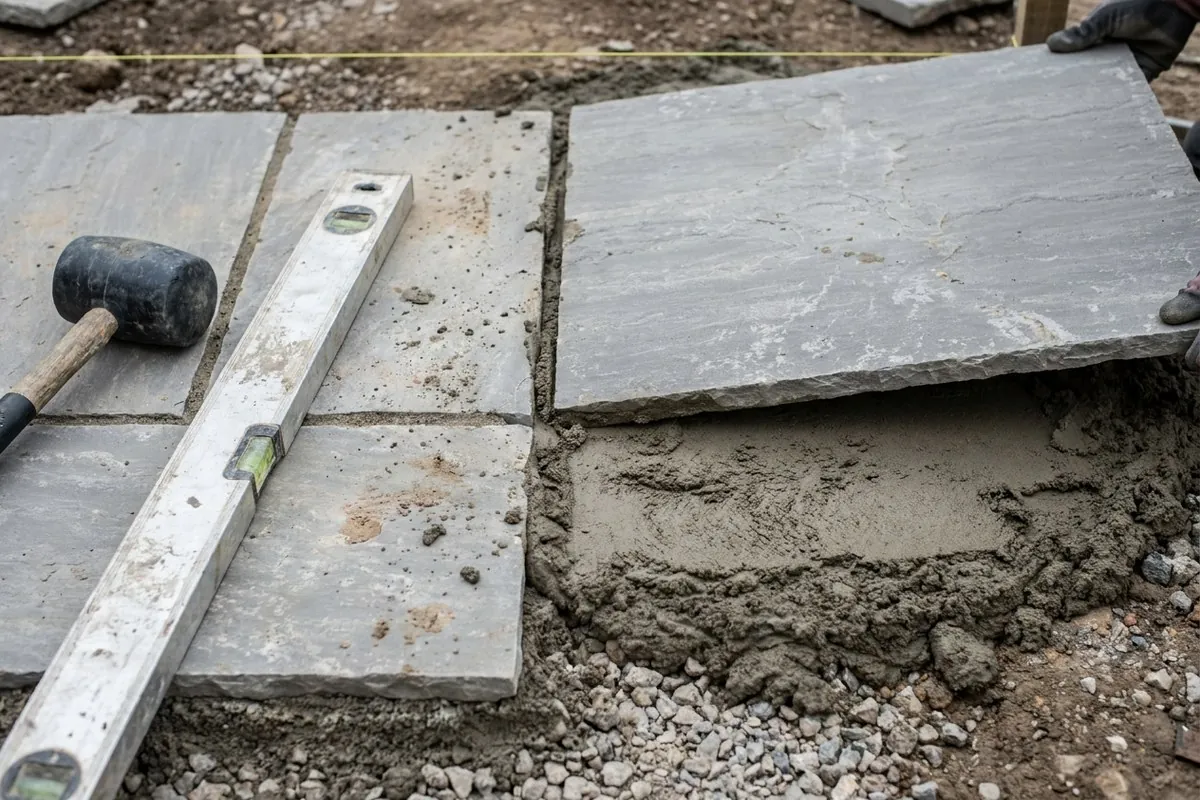
Slabs laid on dabs. Some patios are laid on five blobs of mortar, one under each corner and one in the middle, instead of a full bed. It's quicker and looks the same on the day, but the slab is held at five points with hollows in between. Step near an edge and it pivots, the dabs crack free, and it starts to rock.
Weak or wrong pointing. The pointing keeps water out of the bed. A dry or semi-dry sand and cement mix brushed into the gaps is a common shortcut, and Marshalls says it "does not constitute a true rigid joint." It cracks, falls out, and lets rain in underneath.
Frost. Water in the hollows under a slab, or in a soft base, expands when it freezes, and a slab with nothing solid under it lifts or cracks. That's why problems often show up after a hard winter.
Tree roots. Roots lift a patio rather than sink it, so you get a ridge or a bump. The RHS says most lifting of drives and patios happens within 1m of a tree's trunk, and that cherries in particular have roots close to the surface.
Cracks across a slab nearly always come back to one of these. A slab that's fully bedded on a firm base has nowhere to bend.
How can I tell which problem I've got?
Look after heavy rain, when the patio shows you most.
| What you see | What it usually means |
|---|---|
| One slab rocks and sounds hollow when you tap it | Laid on dabs, not a full bed |
| A patch or an edge has dropped | Thin or uncompacted sub-base, or soft ground underneath |
| The same puddle in the same place after every shower | Not enough fall, so water sits and soaks in |
| Pointing cracked or missing, weeds in the joints | Weak pointing, letting water into the bed |
| Slabs pushed up into a ridge near a tree | Roots |
| Damp on an inside wall that backs onto the patio | The patio sits too high against the damp-proof course |
On that last one: the damp-proof course is a waterproof layer in the wall, just above the ground. Marshalls says finished paving should sit at least 150mm below it, about two courses of brick. Any higher and rain can splash and soak past it into the wall.
Can it be repaired, or does the whole patio need relaying?
It depends on whether the fault is in one place or everywhere.
Lift and relay part of it when the problem is local: one corner, one edge, a few slabs. The rest should be solid underfoot, sound solid when tapped, and already run water away from the house. A root well away from the tree can often be dealt with too, but the RHS warns not to cut large roots close to the tree, and to check for a Tree Preservation Order first.
Relay the whole patio when the base is thin or missing wherever you lift, when most slabs sound hollow, or when it slopes towards the house or sits too close to the damp-proof course. You can't fix the levels of half a patio.
Either way, slabs that come up whole can often go back down.
What doesn't work is packing more mortar under a sunken slab to bring it back up level. It looks right for a while, then drops again, because nothing underneath has changed.
What we'd do
Lift before deciding. We'd take up a slab or two from the worst area, and one from an area that looks fine.
If the base under the good-looking slab is as poor as under the bad one, we'd relay the lot. Repairing one section next to a base that's failing only moves the problem along by a metre. If it's genuinely local, we'd rebuild that section from the ground up, as we did at Harpenden: dig out, membrane, compacted sub-base, full mortar bed, fresh pointing.
We'd rather tell you a repair will do than sell you a patio you don't need, but we wouldn't patch something we expect to sink again.
What should I ask before anyone relays it?
Whoever you talk to, ask these and get the answers in writing:
- What goes under it, how deep, and is it compacted in layers?
- Will every slab sit on a full mortar bed, or on dabs?
- Which way will the water run, and where does it end up?
- How far below the damp-proof course will it finish? At least 150mm.
- What will the joints be filled with?
- For a repair: will you lift a slab and look before deciding?
If you'd like us to come and look at yours, start with our patios.
Questions people ask
Can I fix one rocking slab myself?
If it's one slab on an otherwise solid patio, often yes. Lift it, clear off the old mortar, and bed it back down on a full bed of mortar rather than dabs. If it moves again, or the slabs around it start to, the problem is the base underneath, and rebedding the slab won't hold.
Can you just repoint a rocking patio?
No. Pointing fills the gaps between slabs and keeps water out, but it can't hold a slab still. If the slab moves underneath, new pointing cracks and comes out again. Fix what's under the slab first, then point it.
Can jet washing loosen patio slabs?
It can. A jet washer pointed straight down a joint blasts the pointing out, and that lets water into the bed. Use a wide fan nozzle, keep the lance well off the surface at a low angle, and keep it moving.
Would a different slab have stopped it sinking?
No. Sandstone, porcelain and concrete slabs all sink on a poor base. The slab decides how the patio looks and how much looking after it needs, which we compare in Indian sandstone or porcelain. What's underneath decides whether it stays flat.