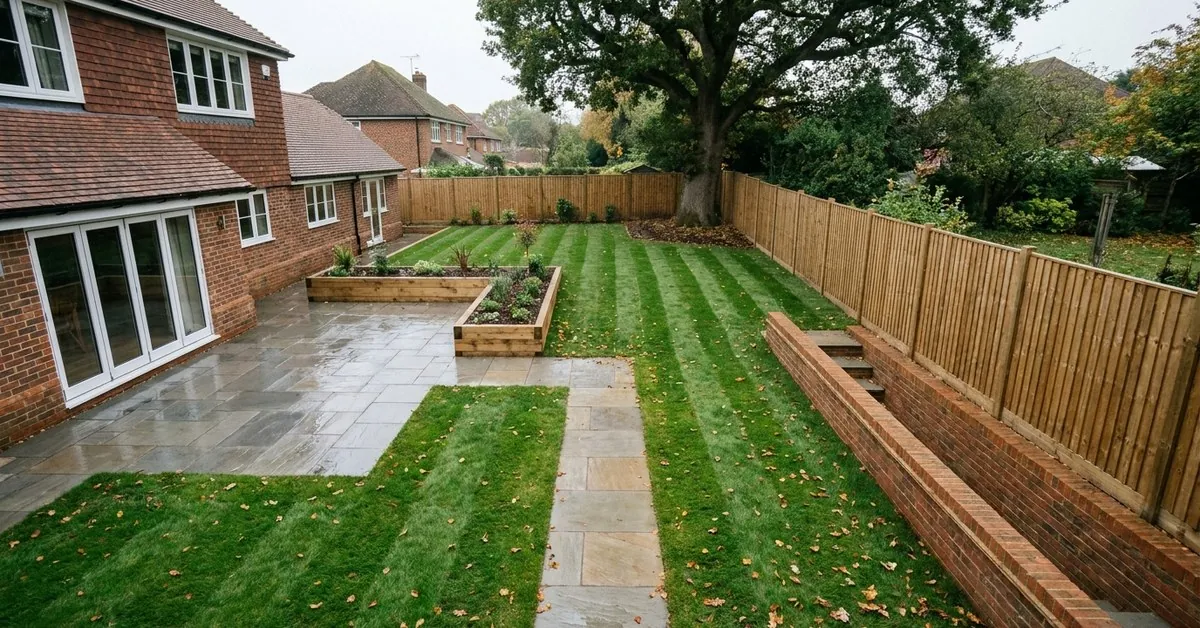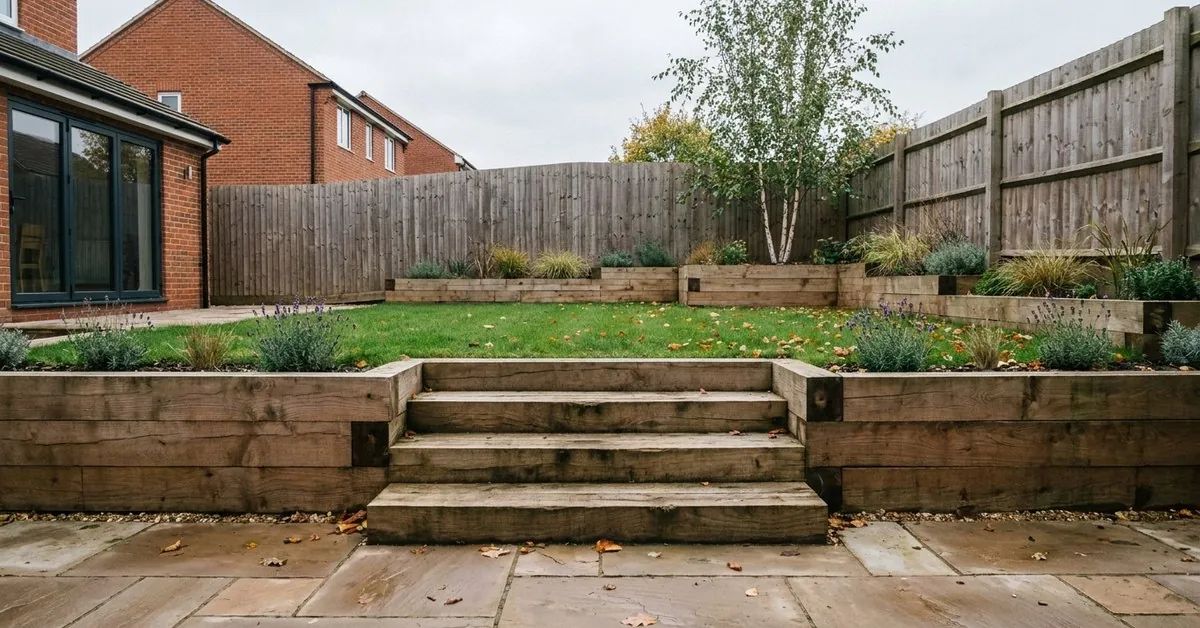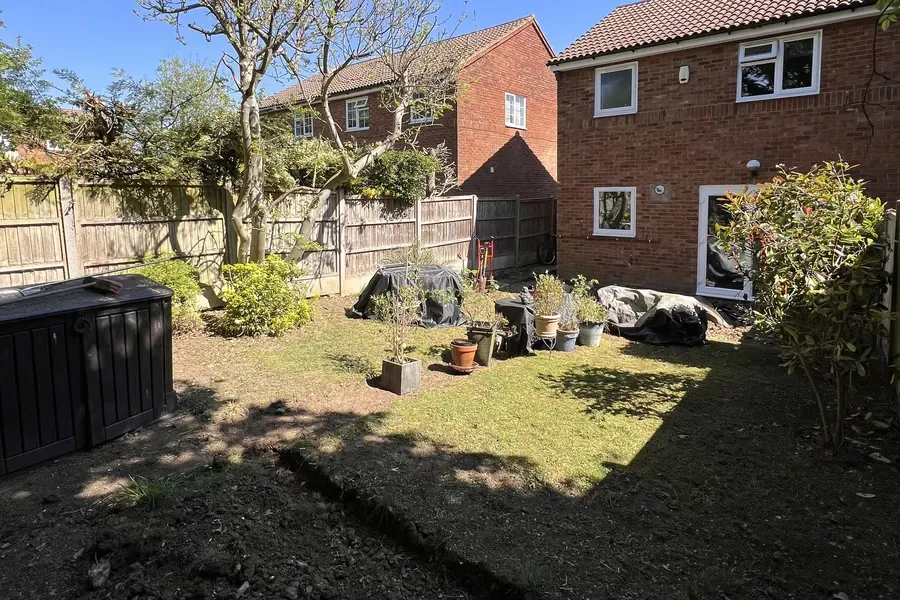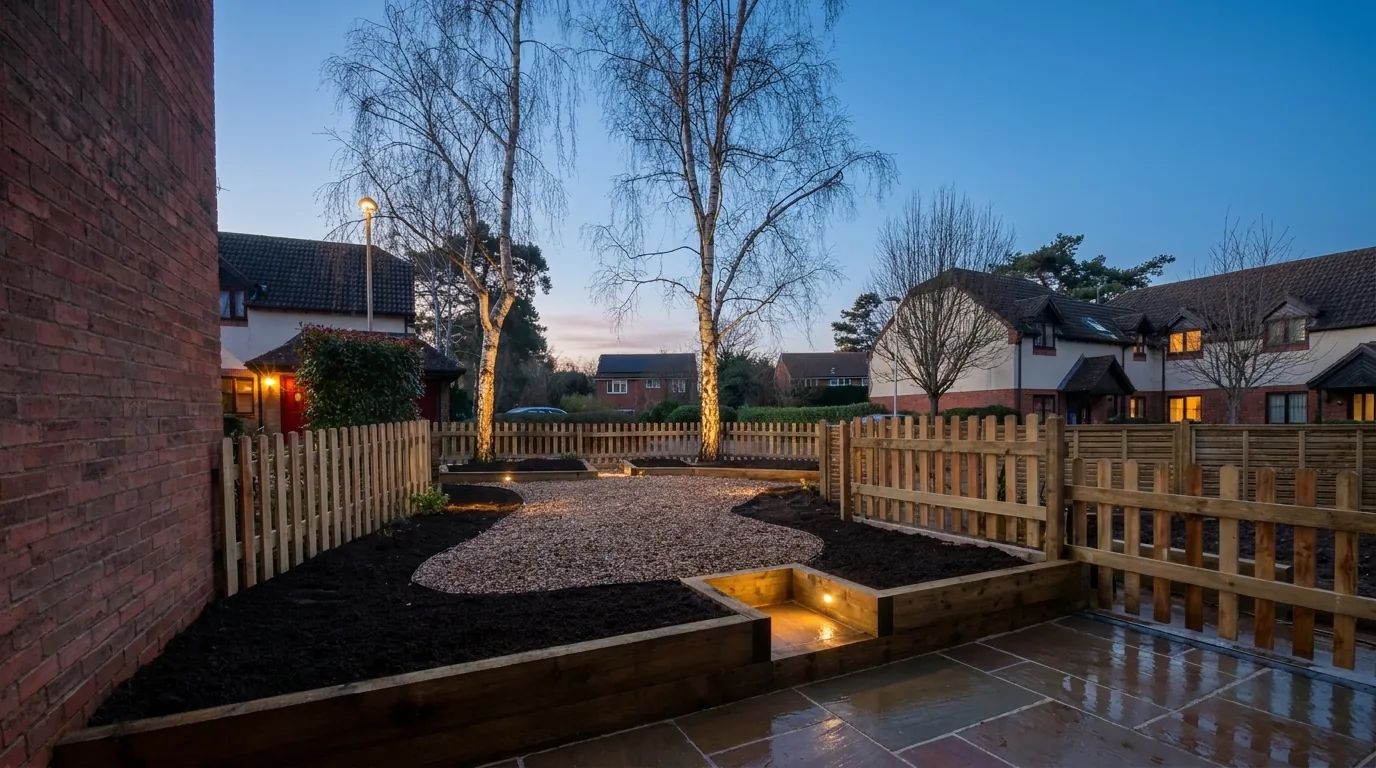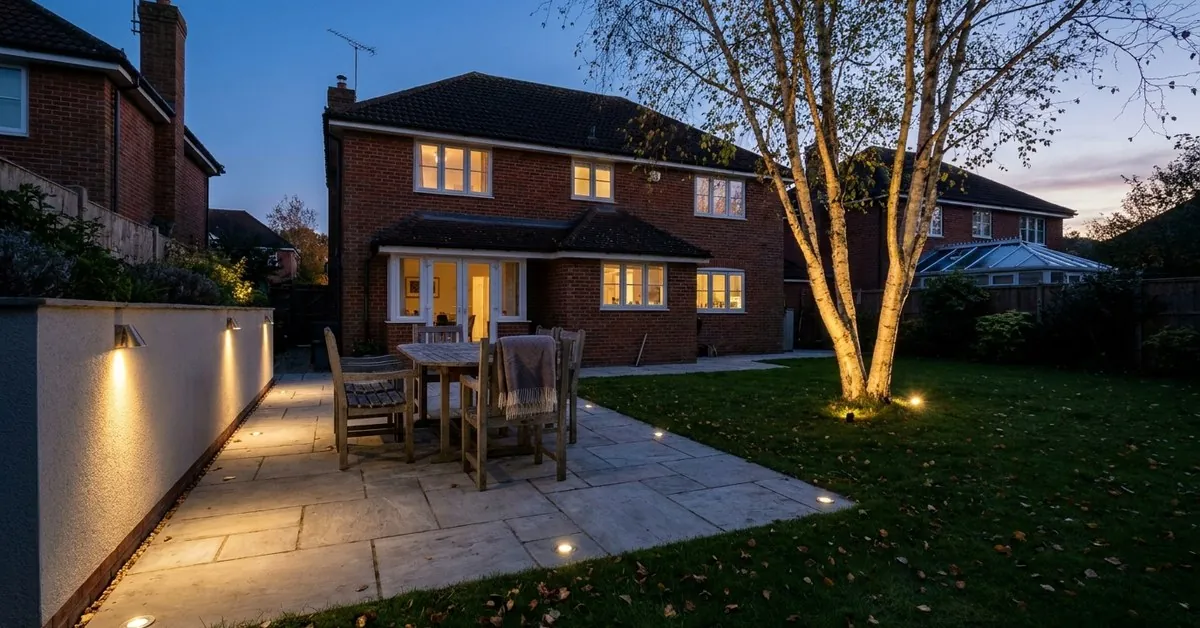
The garden lighting ideas that work are simple: small lights set into the patio, soft light along walls and steps, and one or two spotlights up into a tree. Decide where they go before the build, so the cables run under the paving, then have an electrician wire it.
Once the clocks go back, it's dark by the time most people get home. The garden you spent a summer in becomes a black rectangle outside the kitchen window. A few well-placed lights change that. You can sit out with a blanket on a dry evening, and on the nights you stay in, you still see the garden.
The catch is timing: most of the cable goes under the patio or inside the walls, so it's planned before those are built.
What garden lighting ideas actually work?
The ones we plan in most are the same few. Lights set into the patio, on the floor. Lights along new walls and fencing. And feature lighting, like a spotlight up into a tree or across the patio. It looks good, and it doesn't take many.
| Light | What it does | What to decide before the build |
|---|---|---|
| Lights set into the patio | Soft pools of light on the floor, and you can see where the patio ends | Where each one sits, so the cable runs to it and the slab is cut to take it |
| Steps | Each tread lit, so nobody misses one in the dark | Lights in the step faces or the wall beside them, with the cable run in as the steps are built |
| Walls and fencing | A soft wash of light at seat height | The cable run behind or inside the wall as it goes up |
| A spotlight on a tree | One lit tree, the thing you look at from the window | A cable route out to the tree, and where the light sits in the bed |
| Paths and borders | Low lights along the way you walk | The route, so the cable follows the path or the edge of the bed |
Where should garden lights go?
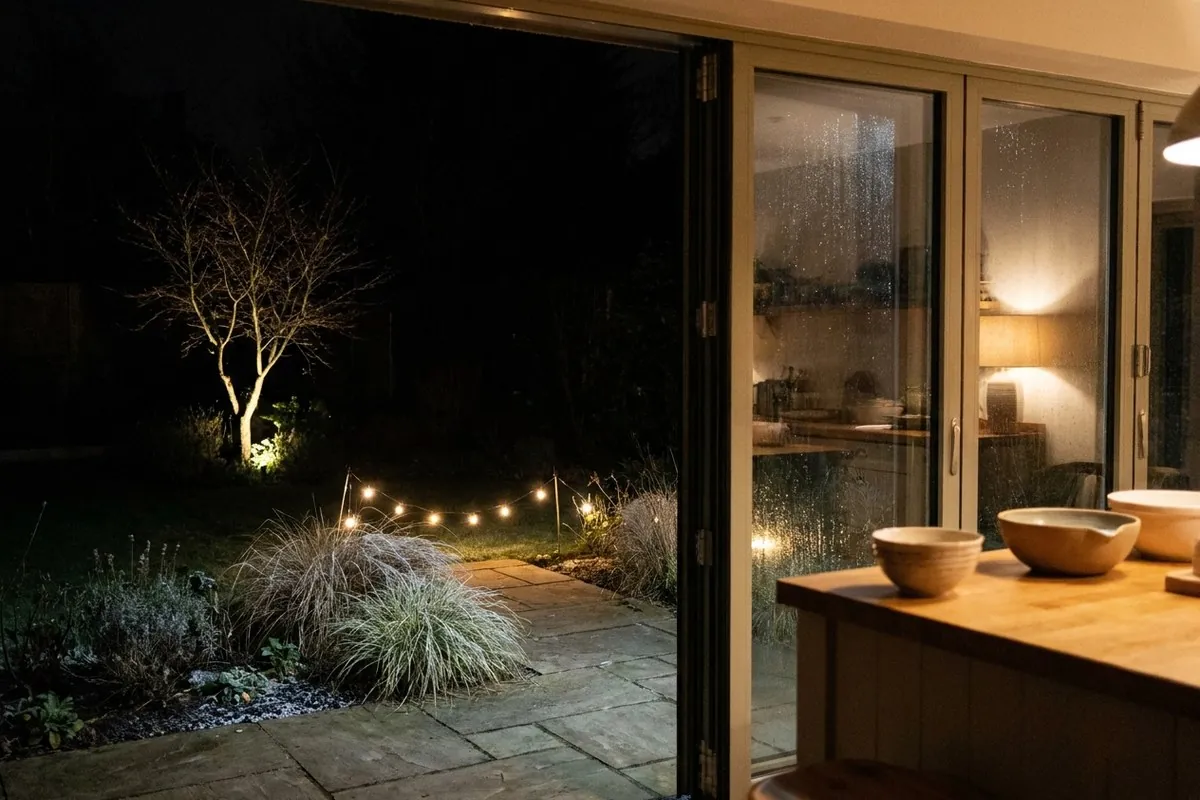
Start inside. Stand at the kitchen window or the back doors on a dark evening and ask what you'd like to see. Usually it's one thing in the distance, like a tree or the back wall, and the patio nearest the house. Light those two and the garden has depth.
Then go outside. Light where you walk (the path, the steps) and where you sit, and leave the rest dark. A few low lights look better than a lot of bright ones. The dark is what makes the lit parts stand out.
The RHS advises keeping light low and aimed across steps and paths, not up into the sky. That's kinder to your neighbours and to wildlife.
What has to be planned before the build?
Where the lights go, roughly, and how the cable gets to them.
When a client mentions lights, we tell them the same thing every time: decide before the job's finished, because otherwise we've got to dig everything back up and relay it.
The cable doesn't go straight into the ground. It runs through a duct, a ribbed plastic pipe we lay while the ground is open. The electrician pulls the cable through it later.
Where the lighting duct sits under one of our patios
- Slab20mm
Porcelain or sandstone. Where a floor light goes, the slab is cut to take it.
- Mortar bed40mm
A full bed of mortar under every slab.
- Sub-base100mm
MOT Type 1, a crushed stone, compacted hard.
- Dug-out ground, with the duct
The duct goes in a trench here, before the stone. Your electrician sets how deep.
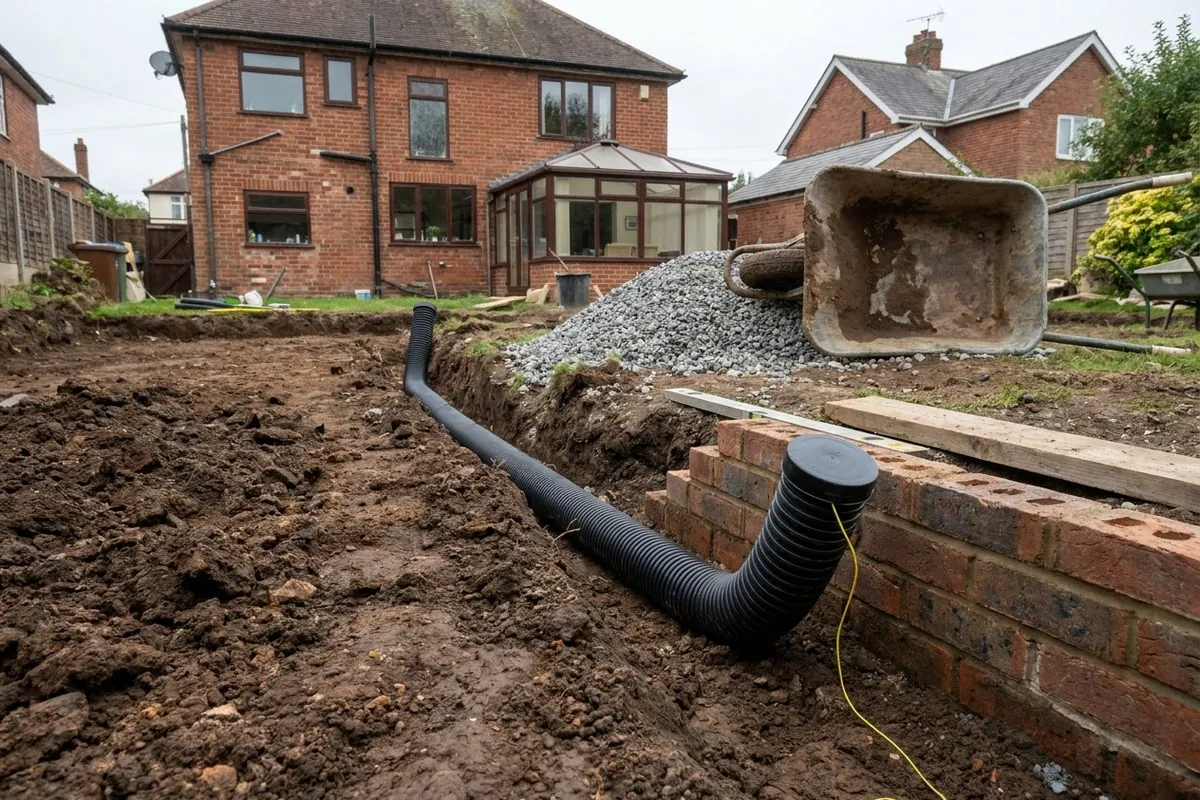
Walls are the same. A cable run inside or behind a wall is easy while it's going up, and hard once it's finished.
Who wires garden lights?
An electrician. We plan the lighting in with the design and lay the ducts and groundwork, and the wiring is done by an electrician we bring in. Who does what:
- DesignWe work out with you where the lights go, and the electrician advises on the circuit and the fittings.
- GroundworkWe lay the ducts while the ground is open, to the routes agreed.
- The buildWalls, steps and paving go up over them, with the fitting positions left ready.
- WiringThe electrician pulls the cable through, fits and connects the lights, and tests it all.
There are rules behind this. In England, fixed lighting in a garden comes under Part P of the Building Regulations, the part that covers electrical safety. Some of that work is notifiable, meaning building control has to be told. Approved Document P lists a new circuit as notifiable, so it applies if your lights need a new circuit from the fuse board. Your electrician will confirm whether they do.
An electrician registered with a competent person scheme can sign off their own work. The Planning Portal says you should then get an Electrical Installation Certificate, and a Building Regulations compliance certificate within 30 days. Keep both. You'll want them when you sell.
Three things your electrician will sort:
- Safety switch. Electrical Safety First says to use an RCD with all outdoor electrical equipment. An RCD is a switch that cuts the power fast if something goes wrong.
- Fittings made for outside. Outdoor lights carry an IP rating, which says how well they keep out dust and water. A light set into paving sits where rain collects, so it needs a higher rating than a light under the eaves.
- Low voltage or mains. Some systems run at low voltage through a transformer, others at mains voltage. Which suits depends on how many lights, how far the cable runs and the fittings you want.
Can you add garden lights after the patio is laid?
Yes, but it's more work than doing it at the start. To run the cable underneath, we lift a few slabs. The other way is to run it across the top, which isn't ideal.
Lifting slabs means cutting out the joints and relaying them on a new bed, then making the new joints match the old. Running a cable over the surface means it's on show, and in the way. Lights fixed to an existing wall or fence are easier, because the cable can often run along the boundary instead of under the patio.
If it's only a little light you're after, solar or plug-in lights need no digging at all. They're dimmer, and solar ones charge poorly on short winter days, when you'd want them most. Still, they're a fair way to start.
Will garden lights bother the neighbours or wildlife?
They can, if they're too bright or pointed the wrong way. The RHS warns about spotlights shining through your neighbour's windows, and suggests keeping lights low, warm in colour and aimed down where you can.
Wildlife is the other reason. Bats and moths are out at night, and the RHS suggests keeping light on trees to a minimum or low down, and not lighting ponds. So if you'd like a tree lit, we'd suggest one, lit from low down with a warm, narrow beam on the trunk. And put the lights on a timer or a switch you use, not on all night.
What we'd do
Decide on lighting at the design stage, even if you're not sure yet what you want. The fittings can wait. The route can't.
If you think you might want lights one day but aren't ready to decide, ask for an empty duct under the patio while it's open. It sits there doing nothing until the day you want it, and it saves lifting slabs later.
Keep it simple: the patio by the house, the steps, and one thing to look at from the window. That's usually enough for the garden to feel like somewhere to be on a winter evening. If you're planning the whole garden, the order it's all built in is in what a full garden renovation involves, and a slope with steps has its own lighting points in sloping garden ideas. Lighting is part of how we design and build gardens.
Questions people ask
Do I need an electrician for garden lighting?
For anything wired in, yes. Fixed garden lighting comes under Part P of the Building Regulations in England, and a new circuit has to be notified to building control or signed off by a registered electrician. Solar lights, and plug-in lights used from an outdoor socket you already have, don't need one.
Do you wire the lights yourselves?
No. We plan the lighting in with the design and lay the ducts, and an electrician we bring in does the wiring, the testing and the certificates.
Can I add lights to my patio later?
Yes, but it means lifting a few slabs to get a cable under, or running it over the top. An empty duct laid while the patio is being built saves that.
How do I light a garden without harming wildlife?
Less of it, kept low and warm, aimed where you need it and switched off when you go in. The RHS suggests keeping tree uplighting to a minimum and not lighting ponds.