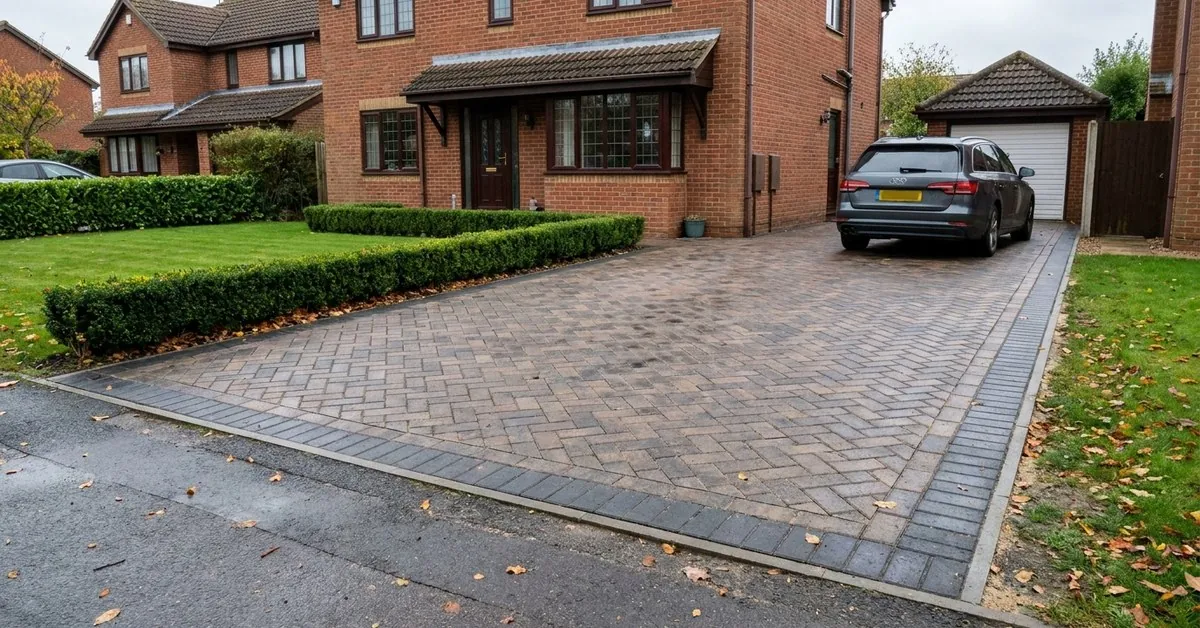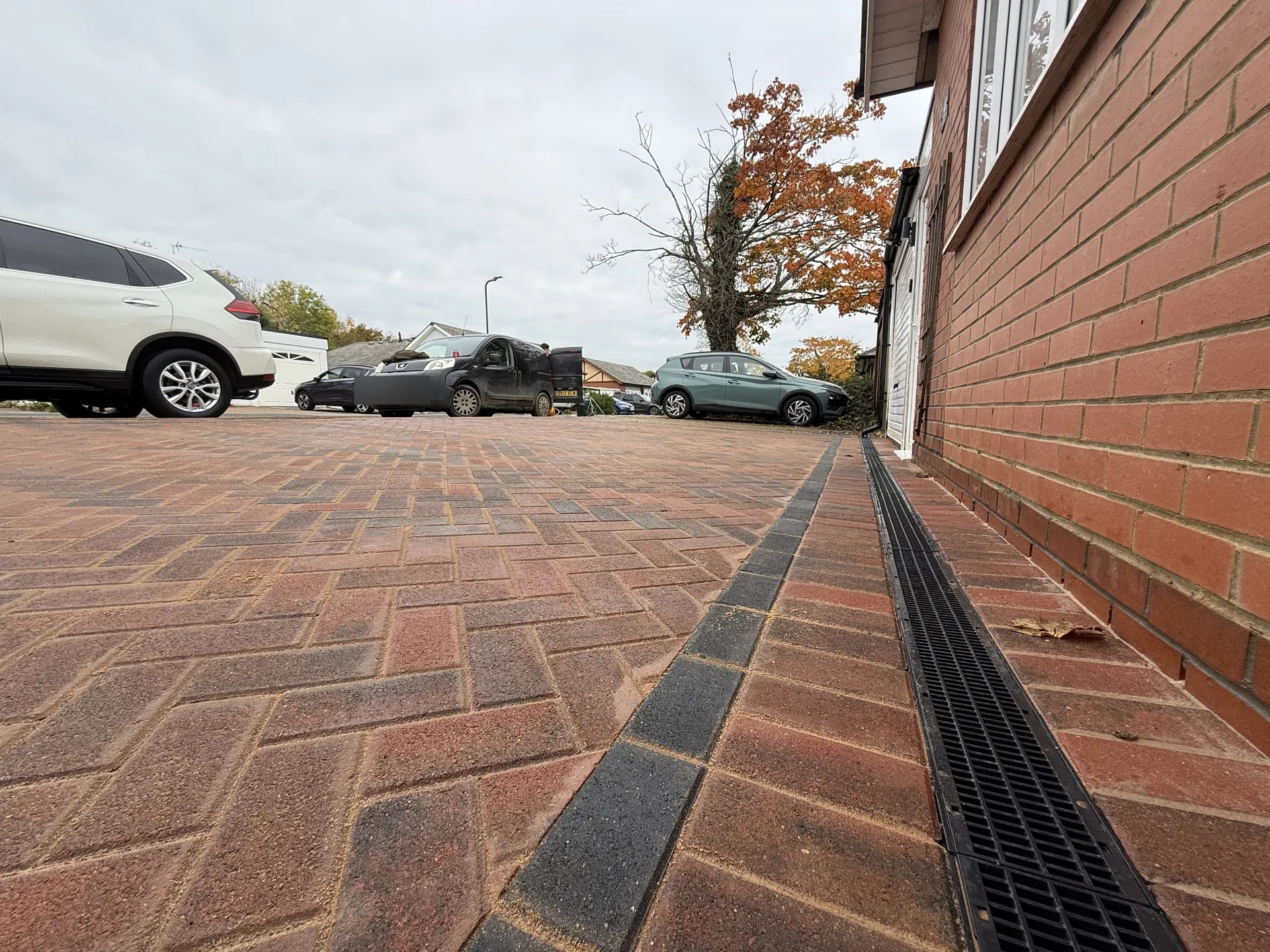
Drainage on a driveway comes down to three places the rain can go: onto a lawn or border beside it, down through the surface into the ground, or into a channel drain (a slim gutter set into the surface) that leads to a drain or a soakaway (an underground pit that lets water soak into the ground). A good driveway has one of these planned for every part, with a gentle slope away from the house.
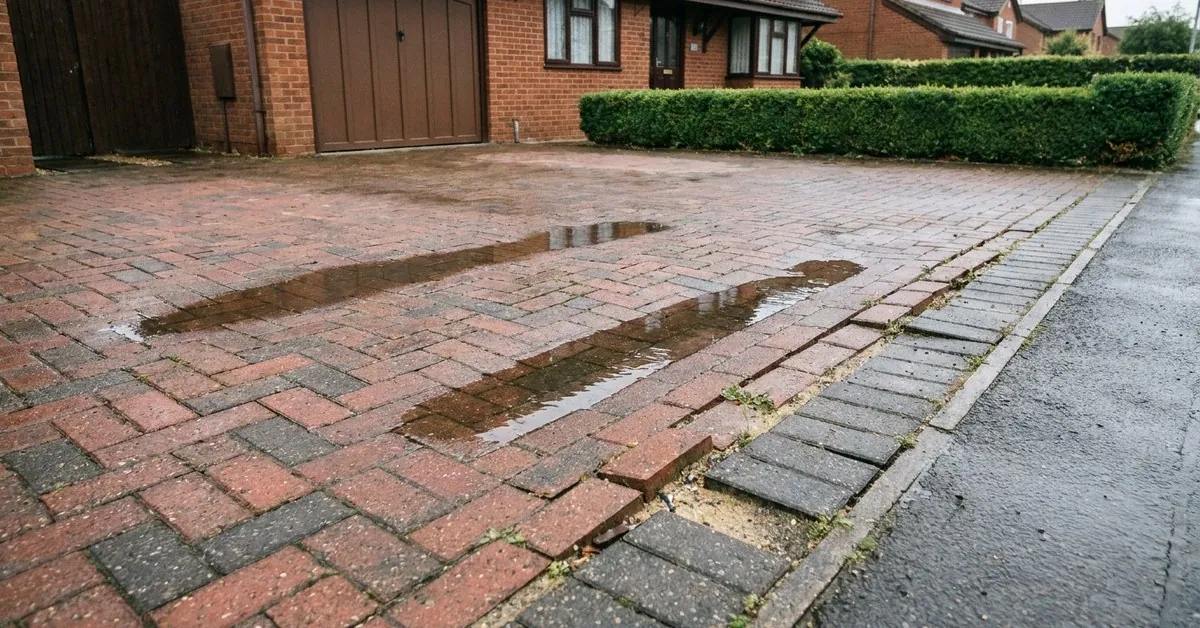
Water across a drive isn't just annoying. A puddle by the door is the bit you can see. The part you can't see is the water soaking through the joints into the base, because wet ground is soft ground.
Why does water flood across my driveway?
Look after heavy rain, when the drive shows you most.
| What you see | What it usually means |
|---|---|
| Water running towards the house or garage | The drive falls the wrong way, and nothing catches it at the bottom |
| A puddle in the same place every time | The drive was laid flat there, or the base has sunk |
| Water sitting across the front of the garage | A channel drain that's blocked, or missing |
| Water running out onto the pavement | The drive has nowhere of its own to send it |
| Green patches or moss in the same spots | Water is sitting there for too long |
| Damp low on an inside wall by the drive | The paving may be too close to the damp-proof course, the waterproof layer low in the wall |
If the drive is also dipping, that's usually a base problem as well as a water problem. Here's why driveways sink, and when a repair will hold.
Where can the water go?
There are three options, and most drives use one or two.
| Option | How it works | Suits | Watch out for |
|---|---|---|---|
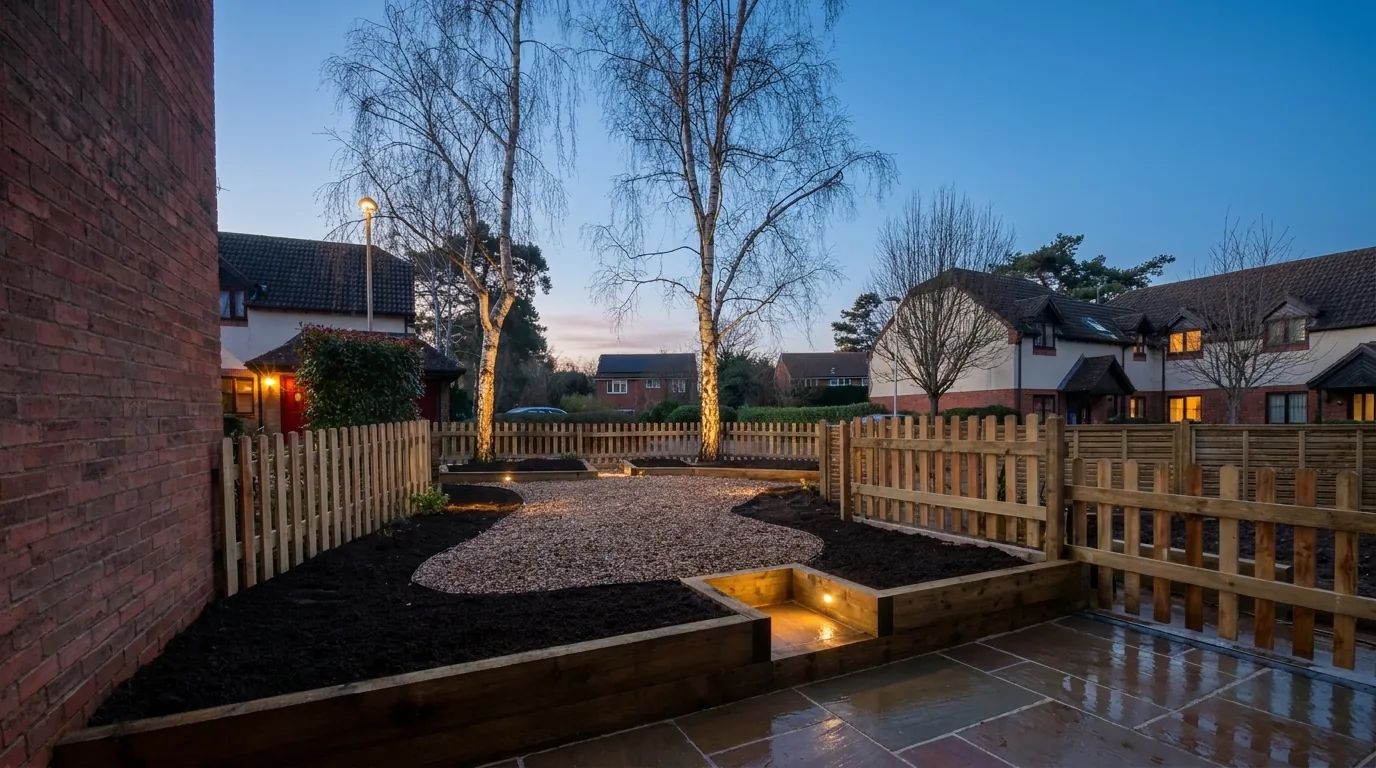
| Lawn or border | The drive slopes to its side, and rain runs onto planted ground | Drives with a lawn or border along the low edge | The ground has to take the water, or it just floods the border |
| Through the surface | A permeable surface and the layers under it let rain soak into the ground | Ground that drains well, tested first | Every layer has to let water through, and it slowly clogs |
| Channel and soakaway | A channel drain catches the water and a pipe takes it to a pit in the ground | Solid surfaces with no border to run to | The soakaway needs ground that takes water, and room to fit |
Water shouldn't just be sent to a neighbour's drive or out to the road. Government guidance on front gardens says sending water to the drains is the last option to consider, and may not be allowed without planning permission.
Do I need planning permission for driveway drainage?
Not usually, as long as the water stays on your own property. That same guidance says a new or replacement front drive over 5 square metres needs planning permission unless it lets water through, or the rain runs to a border or a soakaway. Five square metres is less than half a parking space, so this covers most drives.
Standard block paving doesn't let water through, so on those drives we plan where it goes: usually a border, a lawn or a soakaway. If you're in a conservation area or a listed building, check with your council.
Which way should a driveway slope?
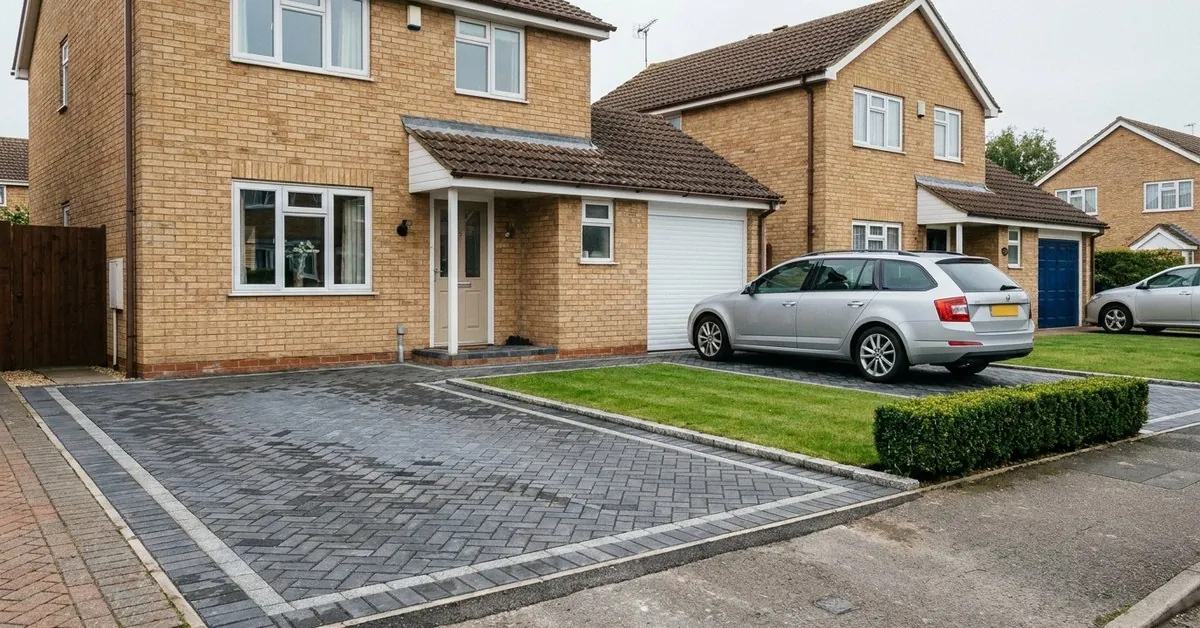
Away from the house, wherever you can. The Building Regulations guidance recommends at least 1 in 60 on a solid surface. That's 1cm of drop for every 60cm of drive, enough to move the water and hardly noticeable when you walk on it.
It also has to finish at least 150mm below the damp-proof course, with air bricks (the small vented bricks near the ground) left clear.
On a Milton Keynes extension, the plan had a shingle strip along the house wall. We left it out on site, because held between two edges it would have trapped water against the house. The blocks run right up to the wall and slope away from it instead.
When do you need a channel drain?
When the drive has to run towards the house or garage, or when there's nowhere else for the water to run off. A channel drain is a long, slim gutter set into the surface with a slotted grate on top.
In Beanhill, a drive we built runs right up to the house, so the rain needed somewhere to go other than the walls. A drainage channel runs the length of the house, and the garage downpipe is connected straight into it.
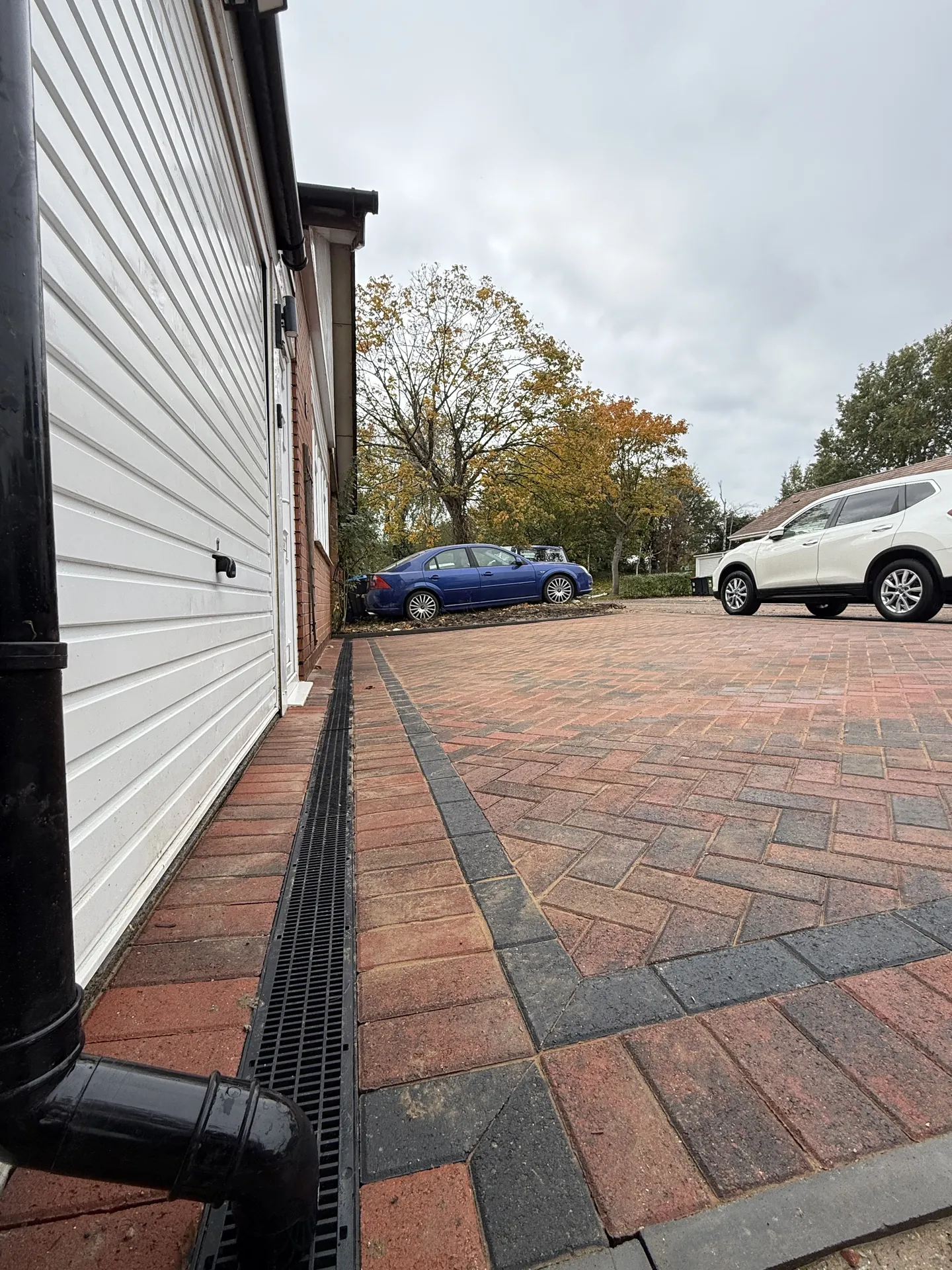
Channels collect grit, leaves and mud off tyres. So ask for a silt trap to catch the dirt and a grate you can lift.
A drive that drains to a channel and a soakaway
Will a soakaway work on my driveway?
Only if the ground takes water, and you can't tell that by looking at it. In heavy clay, the water barely moves. The pit fills up and stays full, and the next storm has nowhere to go.
So the ground should be tested first. A percolation test means digging a pit where the soakaway would go, filling it with water and timing how fast it drains, three times over (the standard method is called BRE 365). It tells you whether the ground takes water, and how big the soakaway needs to be. A soakaway sized without a test is a guess.
Is a permeable driveway the answer?
Sometimes, but "permeable" is a word that gets used loosely. A surface only lets water through as well as the tightest layer under it.
Resin is the usual mix-up. Resin-bound lets water through. Resin-bonded doesn't. And resin-bound on a concrete slab isn't permeable either, because the water goes in and stops at the concrete. That's a good way to build a drive, as long as the concrete slopes to a channel. It just shouldn't be sold as permeable.
The stone matters too. The usual crushed stone under most drives, MOT Type 1, packs down so tight that water barely passes through. A real permeable build uses a coarser stone with the fine dust left out. That stone is weaker, so it goes deeper: our permeable gravel build has 250mm of it, where a standard drive has 150mm of Type 1.
We only build that where a percolation test says the ground drains. Over clay, it's a tank with no way out. And over five to ten years, mud off tyres slowly clogs it.
What we'd do
Decide where every drop goes before anyone digs. That means checking the levels against the house, and looking at what's already there: downpipes, drains and borders.
If there's a lawn or border along the low side, we'd use it. It's the simplest answer, with nothing to clear out.
If there isn't, we'd run a channel drain to a soakaway and test the ground first. Where the test fails, the answer is a different plan, not a soakaway that never empties.
Here's how we build driveways.
Questions people ask
Can my driveway drain onto the road?
You shouldn't plan on it. For a new or replacement front drive over 5 square metres, the planning rules want the water dealt with on your own property, unless the surface is permeable. Tipping it all onto the pavement isn't the answer. Check with your council if you're unsure.
Can a downpipe go into a driveway channel drain?
It can, as we did at Beanhill, as long as whatever the channel leads to can take the extra water. A soakaway sized for the drive alone may not cope with a roof as well, so tell whoever's designing it.
How do I test if my drive is really permeable?
Run a hose on it for a minute or two. Government guidance says there should be no puddles, and water should soak in without running more than 200 to 300mm across the surface.
Can you fix drainage without relaying the whole drive?
Often, yes, if the problem is only the water. A channel can be cut in at the low end, with the blocks around it relaid. If the base has already sunk, or the whole drive falls the wrong way, a channel won't fix that. We'd lift a section first and show you.