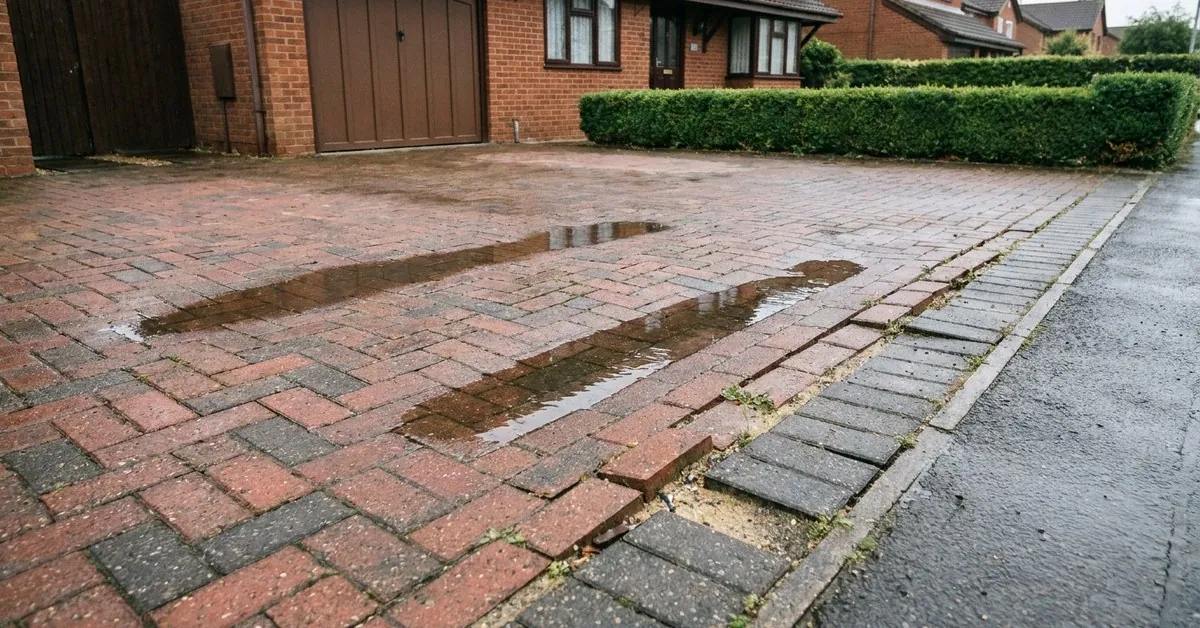
An uneven driveway is nearly always a problem underneath, not with the blocks or tarmac on top. Usually there was too little stone under it, or no membrane (a fabric sheet that keeps stone and soil apart), so the stone has pushed down into the soil and the drive is sinking with it. A sunken patch can be lifted and rebuilt, but if the base is poor everywhere, the rest of the drive can go the same way.
Most people who ring us about a dipping drive don't know what's gone wrong. They just know it has: a hollow where the car parks, a puddle that never dries, blocks that rock underfoot. Some know they had a bad job done.
Either way, the answer is under the surface. You can work out a lot of it before anyone lifts a block.
Why is my driveway sinking?
A drive is built in layers, and the car's weight goes down through all of them. This is what should be under a block paving drive, and what we lay:
What should be under a block paving drive
- Blocks50mm
The surface you see. It only stays flat if everything under it does.
- Laying course40mm
Sharp sand, levelled so every block beds down evenly. It isn't there to fill dips.
- Sub-base150mm
MOT Type 1, a crushed stone, compacted in layers. This is what carries the car.
- Membrane
A tough fabric sheet that keeps the stone and the soil apart.
- Dug-out ground
Taken down to firm soil before anything goes in.
When we lift a sunken drive, we usually find the stone underneath is barely there, or there's no membrane. So the stone has gone into the soil, and the drive has started to sink.
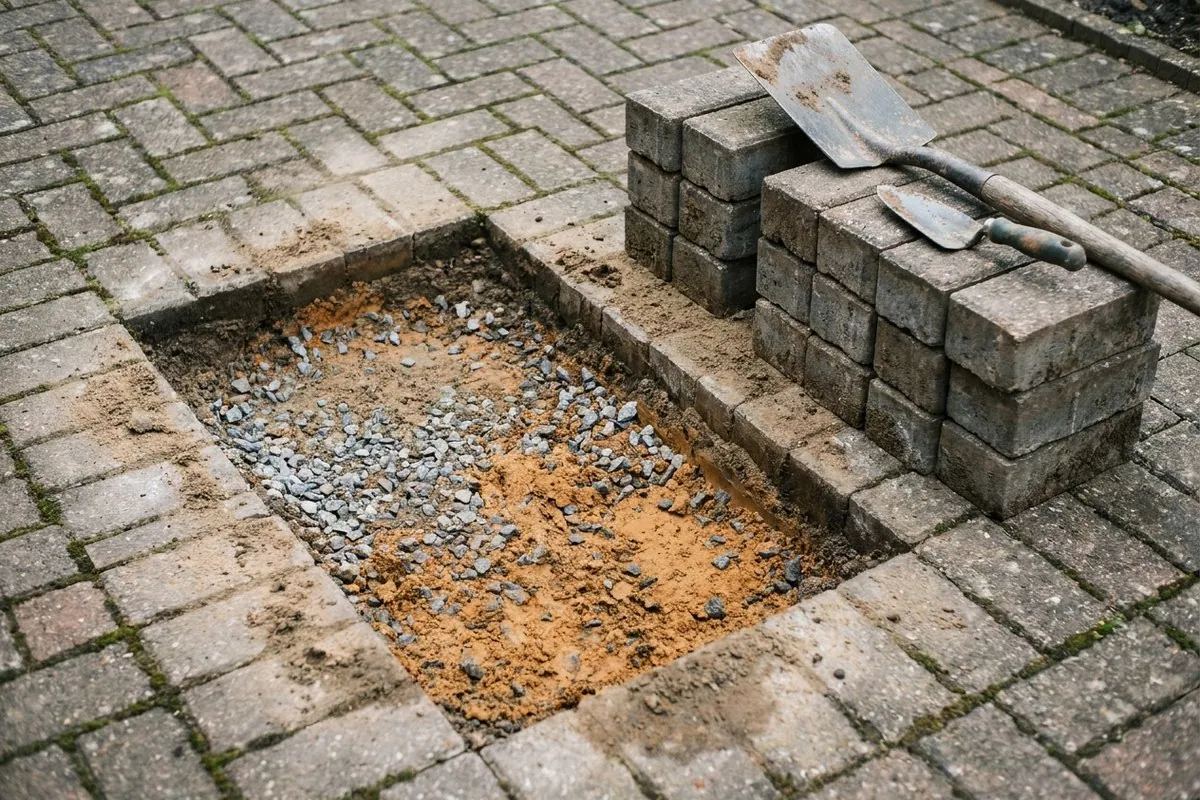
The membrane matters more than it looks. Without it, every car that rolls over the drive presses the stone a little further into the soil, and the soil works up between the stones. The base gets thinner and softer, and the surface follows it down. Marshalls, the paving manufacturer, says in its guide to laying block paving that it's a good idea to use a membrane "that will stop the hardcore going into the sub-soil." Hardcore is the crushed stone.
That's why the dip is nearly always where the wheels sit. The car is the heaviest thing on the drive, and it parks in the same place every night.
What else makes a drive go uneven?
- Clay ground. Clay swells when it's wet, then shrinks and cracks as it dries, the British Geological Survey explains. A thin base on clay moves with the seasons.
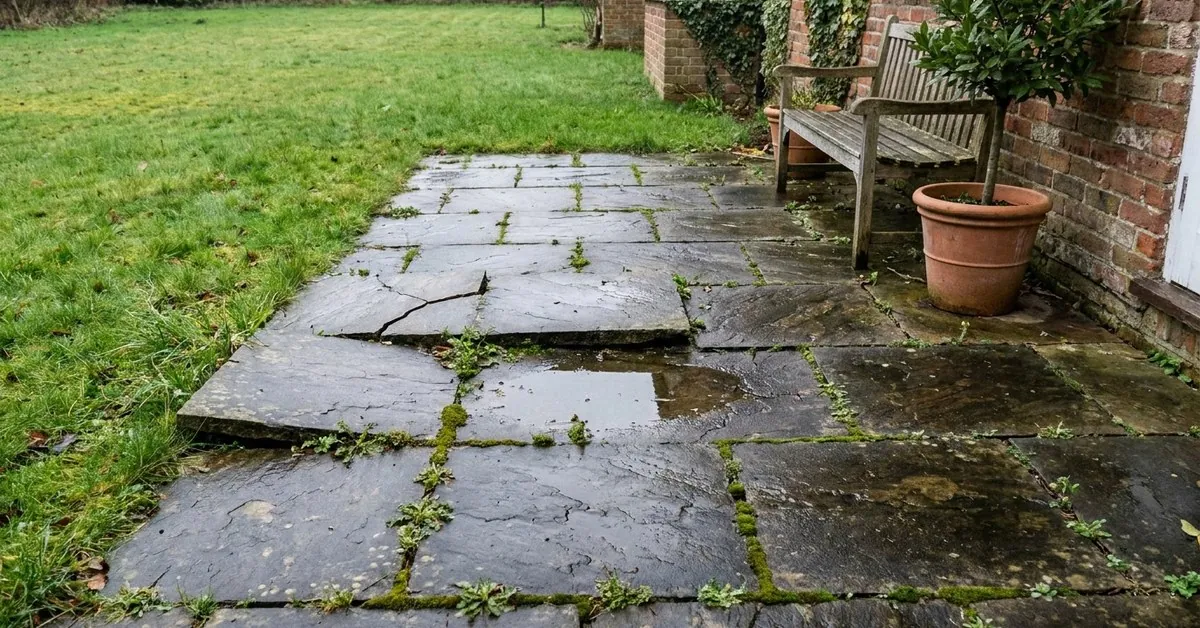
- Water underneath. A drive with no fall, the gentle slope that sends rain away, holds puddles, and the water soaks down through the joints. Wet ground is soft ground. A broken drain or an old soakaway (a buried pit that rainwater drains into) under the drive does the same thing from below.
- Edges that weren't held. If the kerbs or edge blocks aren't set in concrete, the side creeps outwards and drops, and the joints open behind it. We explain why in what makes a block paving driveway last.
- Tree roots. Roots lift a drive rather than sink it, so you get a ridge or a bump near the tree.
How can you tell what's wrong with an uneven driveway?
Look after heavy rain, when the drive shows you most.
| What you see | What it usually means |
|---|---|
| Two dips where the car's wheels sit | A thin base, or stone pushed into the soil under the weight |
| A dip with a puddle that never dries | The base has sunk there, and the water soaking in is making it worse |
| One side has dropped, with the joints open along it | The edge wasn't held in concrete and is creeping outwards |
| Dips all over, in no pattern | A poor base under the whole drive |
| A dip over the line of a drain, or by a downpipe | Possibly a broken pipe or soakaway washing the ground away |
| A ridge or bump near a tree | Roots |
Can a sunken driveway be repaired, or does it need relaying?
Block paving can be lifted and relaid, so a sunken patch can be repaired: lift it, dig out what's underneath, put a proper base in, and relay. Tarmac and concrete can't be lifted like that. The failed section is cut out and replaced, and the join usually shows.
The catch is what's under the patch. If the rest of the drive is sound and one spot has failed, perhaps over an old drain, a patch is the right repair.
We can repair a sunken patch. But if there's no stone under it, we can't guarantee the rest of the drive won't sink. If it was built the same way all over, it can happen anywhere else as well. On a drive like that, a patch is at your own risk.
| Patch repair | Relay the whole drive | |
|---|---|---|
| When it's right | One area has failed, and the base is sound where we lift elsewhere | A thin or missing base wherever we look, or dips in several places |
| What it fixes | The dip you can see | The cause, under the whole drive |
| The risk | Other areas can still sink if the base is poor there too | A bigger job and more disruption up front |
| The guarantee | It can't cover the parts we haven't rebuilt | All of it is new, and our structural guarantee is ten years on the sub-base construction |
What doesn't work is packing more sand under sunken blocks to bring them back up, or laying new tarmac over the dip. It looks right for a while, then drops again, because nothing underneath has changed. Whoever does the repair, ask what their guarantee covers. Here's what a landscaping guarantee should cover.
What we'd do
Lift before deciding. On a block drive, we'd take up blocks at the worst dip and in a part of the drive that looks fine, and show you both.
If the base under the good part is sound, we'd repair the dip properly: dig out, membrane, compacted stone, your own blocks back down, fresh sand in the joints. We'd check for a drain or soakaway under it too. If water is washing the ground away, a new base will go the same way.
If it's as poor under the good part as the bad, we'll say so. You'll have seen it yourself before you choose between a patch and the whole drive.
If the whole front drive comes up, the planning rules for a new drive can apply. Government guidance says a new or replacement drive over 5 square metres needs planning permission unless the surface lets water through, or the rain runs to a lawn or border. We plan where the water goes on every front drive. Check with your council if you're in a conservation area.
What should you ask before anyone repairs it?
Whoever you talk to, ask these:
- Will you lift a section and show me what's under it before you price the repair?
- If there's no stone or no membrane, what goes back in, and how deep?
- Will the stone be compacted in layers?
- Is there a drain or soakaway under the dip, and will you check it?
- If you only patch it, what happens if the rest of the drive sinks?
There are more in questions to ask a landscaper before you hire one. If you'd like us to look at yours, start with how we build driveways.
Questions people ask
My drive is only a couple of years old and it's sinking. Is that normal?
No. A properly built drive shouldn't sink within a few years. Find any paperwork and guarantee, take photos of the dips after rain, and go back to whoever laid it first.
Can new tarmac or resin go over an uneven drive?
Not over one that's sinking. A new surface follows the old base down, and resin cracks over anything that moves. The base has to be put right first.
Can my old blocks be reused?
Usually, yes. Blocks that come up whole are cleaned off and relaid. Where some are broken, new ones can often be matched, as we did on the Milton Keynes driveway, though new blocks look brighter at first.