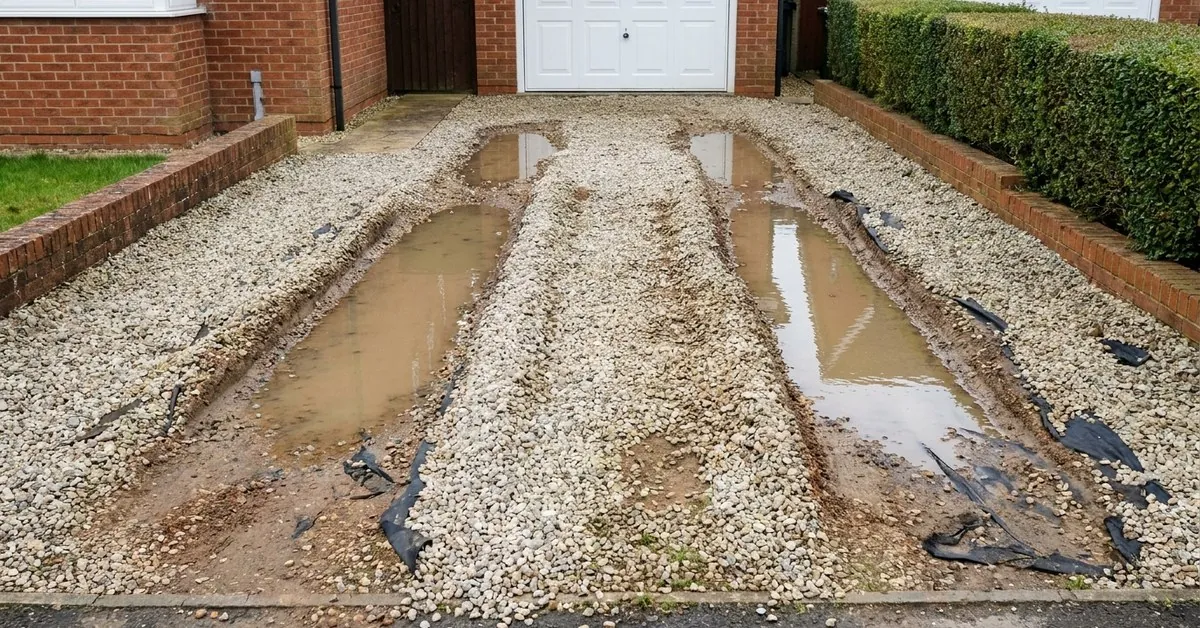
Ruts in a gravel driveway happen because loose gravel has nothing holding it in place, so every tyre pushes a little of it aside. Often the stone base underneath has sunk into the soil too. Shallow ruts on a firm base can be raked out. Ruts that keep coming back need the base putting right and a gravel grid, a plastic honeycomb that locks the stones in place.
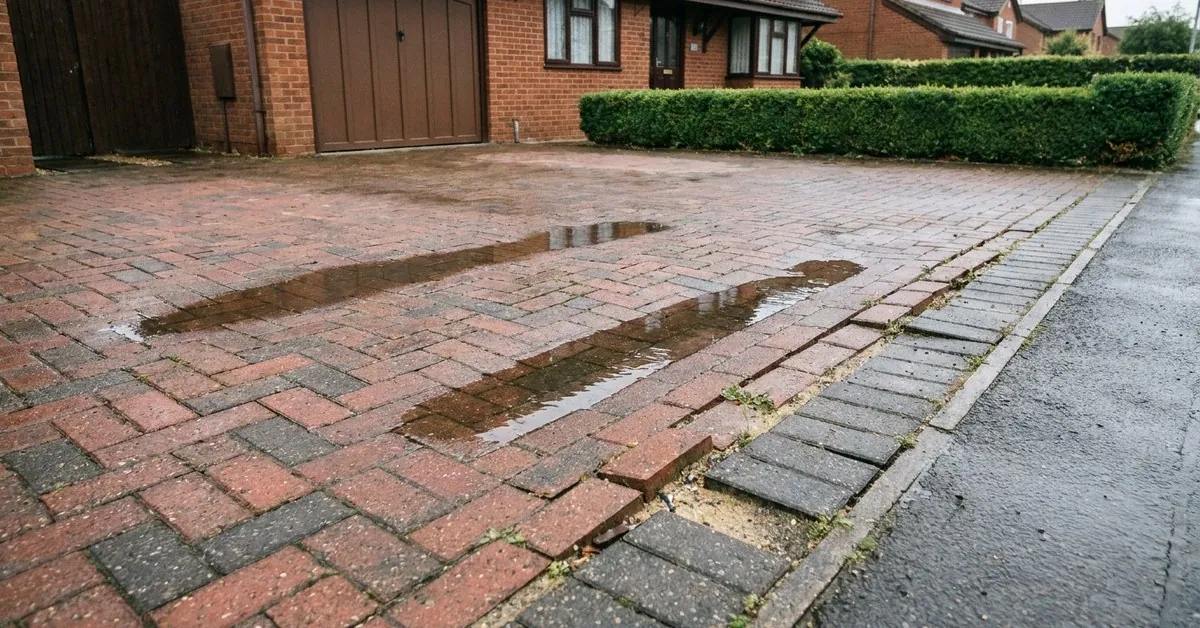
It usually starts with two tracks where the car goes, with the gravel piled up between them and along the edges. After rain they fill with muddy water. You rake them back, and a few weeks later they're there again.
Raking moves the stone back. It doesn't change why it moved.
Why does a gravel driveway get ruts?
There are two causes, and most rutted drives have both.
The gravel is loose. On a plain gravel drive, nothing holds each stone in place. A turning tyre pushes stones sideways, and a tyre pulling away throws them backwards. The government's guidance on front garden surfaces puts it simply: loose gravel "will scatter or form waves."
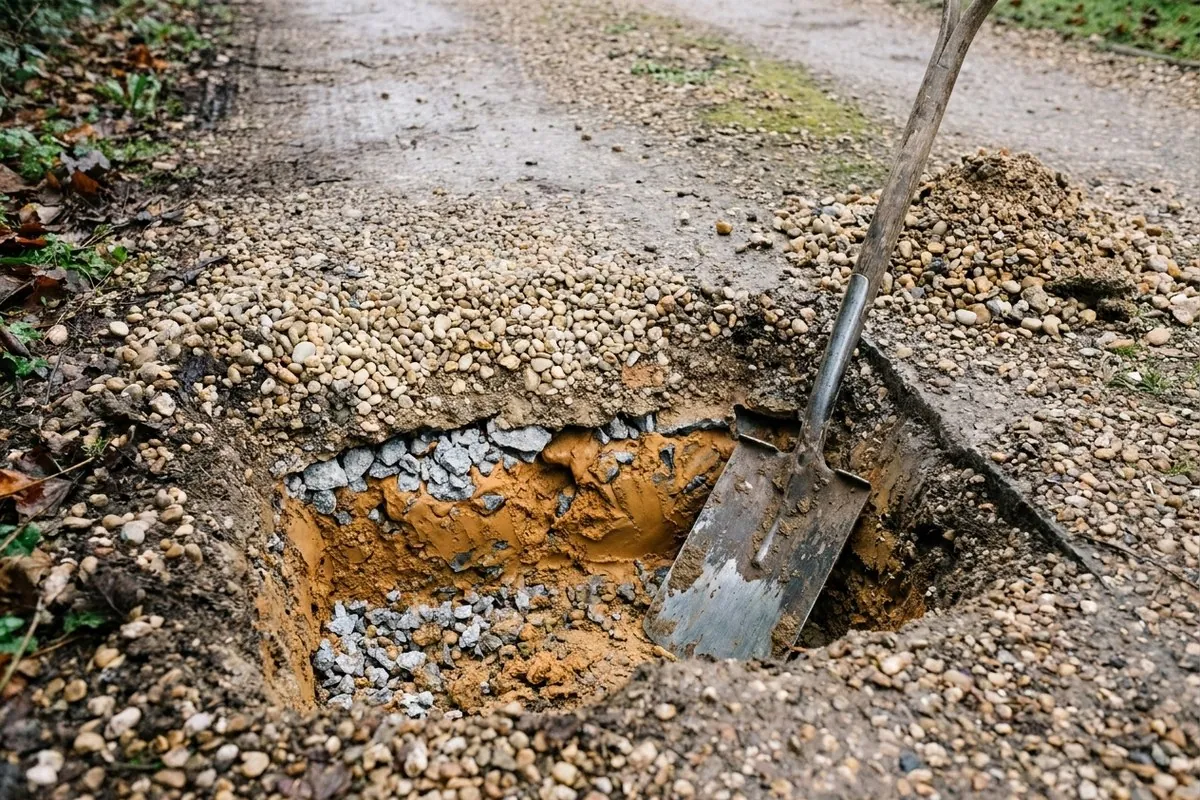
The base underneath has sunk. Under the gravel there should be a layer of compacted crushed stone that spreads the car's weight, so, in the same guidance's words, "the soil below is not overstressed." When we dig into a sunken drive, we usually find hardly any stone, or no membrane (a fabric sheet that keeps stone and soil apart). So the stone has gone into the soil, and the drive has sunk with it.
Water makes both worse. A rut that holds a puddle soaks the ground under it, wet soil is soft, and the next car presses the rut deeper. Mud comes up into the gravel, and weeds follow.
Is it the gravel or what's under it?
Look at the drive after heavy rain. Then rake the gravel out of the worst rut and see what's underneath.
| What you see | What it usually means | Will raking fix it? |
|---|---|---|
| Shallow tracks, firm grey stone under the gravel | Loose gravel being pushed aside, nothing more | Yes, for a while |
| Scooped hollows where you turn or pull away | Tyres throwing the stone out | Yes, but they come back |
| Ruts that hold muddy water after rain | The base has sunk where the wheels go | No |
| Brown soil or mud under the gravel | No stone base, or it's gone into the soil | No |
| A torn black sheet showing through | Gravel tipped onto a membrane with little or no stone under it | No |
| Gravel creeping onto the pavement or lawn | Edges that don't hold the stone in | Raking moves it back, an edge stops it |
Firm stone means the problem is on the surface. Soil, mud or a torn sheet means it's underneath.
Can you just rake it back and top it up?
Sometimes, yes. If the ruts are shallow and the stone under them is firm, rake the gravel level, top up where it's thin, and you may not need anyone. It's what we tell our own clients to do with gravel every so often, because stone gets carried off on shoes and tyres.
What doesn't work is filling deep ruts with more loose gravel. They come back where they were, because the stone still has nothing holding it and the ground under it is still soft.
How do you stop ruts in a gravel driveway for good?
Two things: a base that carries the car, and a gravel grid on top of it.
A gravel grid is a tray of plastic cells, like a honeycomb, laid on the compacted stone and filled with gravel. Each stone sits in a cell, so a tyre can't push it into a rut and rain can't wash it down the drive. Filled, it looks like any other gravel drive. Without one, a gravel drive will rut, however good the gravel.
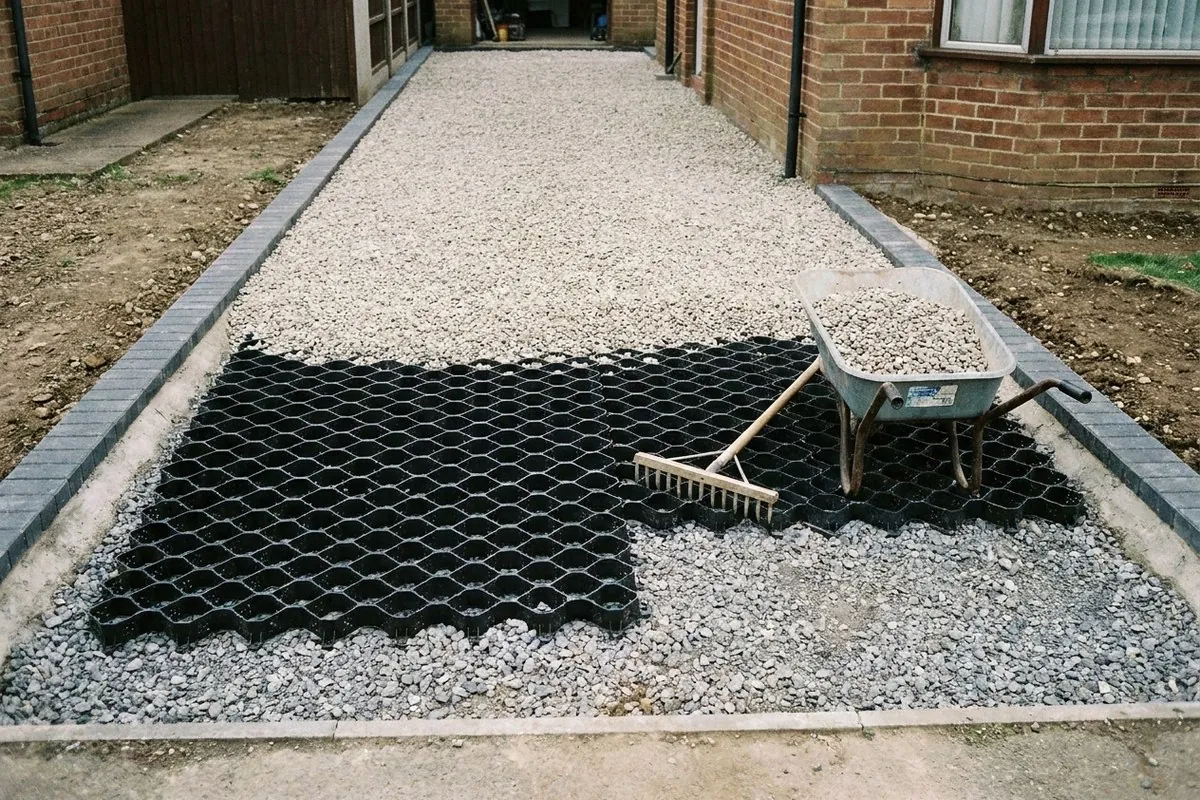
This is what goes under every gravel drive we build:
What should be under a gravel drive
- Grid filled with shingle50mm
The honeycomb grid, filled with 10mm shingle (small rounded gravel). It stops the stone moving.
- Sub-base150mm
MOT Type 1, a crushed stone, compacted in layers. This is what carries the car.
- Membrane
Keeps the stone and soil apart, so the base can't sink in.
- Dug-out ground
Taken down to firm soil first.
Can a grid go over the gravel you've got?
Only if the base under it is sound. One grid maker, Nidagravel, says its grids can go over an existing base as long as it's sound and any damage is repaired first. A grid on soft ground just sinks with it.
So it depends on what's under your ruts. If the stone is firm, the gravel can be scraped off, the base levelled and topped up, the grid laid and the gravel put back. If the stone has gone into the soil, the drive needs digging out and rebuilding.
We can fix just the worst rut. But if there's no stone under it, we can't promise the rest won't go the same way. On a drive built like that, a patch is at your own risk.
What we'd do
Dig before deciding. We'd open a small hole across the worst rut and another where the drive looks fine, and show you both, so you've seen what's under it before you choose anything.
If the base is sound, we'd lay a grid over it and refill. If it's poor, we'd rebuild it properly: dig out, membrane, compacted stone, grid, shingle, and an edge that holds it all in.
We'd also be straight with you: a grid isn't a cheap extra. It costs nearly as much as the blocks on a block paving drive, so a properly built gravel drive is only a little cheaper than block. If one gravel quote is far lower than the rest, ask whether there's a grid in it. Without one, it's gravel tipped onto a membrane, and that's the build that ruts.
What should you ask before anyone fixes it?
- Will you dig a hole across the worst rut and show me what's under it?
- Is there a gravel grid in your price?
- How deep is the stone base, and is it compacted in layers?
- Is there a membrane under the stone?
- What holds the gravel in at the edges and the entrance?
There are more in questions to ask a landscaper before you hire one. If your drive is block paving or tarmac rather than gravel, see why a driveway sinks, and when a patch will hold. And if you'd like us to look at yours, start with how we build driveways.
Questions people ask
Is gravel a bad idea for a driveway?
Not if it's built on a grid. It drains through itself and it's simple to top up. The trade-offs: you'll rake it now and then, it's hard work for a pushchair or a wheelie bin, and some stone gets carried into the house.
Does a gravel drive need drainage?
Usually less than a solid drive, because rain soaks through the gravel. Gravel is one of the surfaces the government guidance counts as letting water through. On heavy clay the water still needs somewhere to go, so it's worth knowing where the water goes on a driveway before you choose.
Will the grid show through?
Not once it's filled. If it starts showing in places, rake gravel across from a fuller patch. Pulling away hard or spinning the wheels throws stone out of the cells, so that's the habit to avoid.
Can you have a gravel drive on a slope?
Loose gravel, no. The government guidance says it's not suitable on steeply sloping drives, because it runs downhill. A grid holds it much better, but on a steep drive a solid surface is often the better choice.